Critiquing the April 2013 CicLAvia

I am no Debbie Downer.  I enjoyed CicLAvia once again, particularly the parts where we passed my old high school and seeing the "StoopidTall" Bike. 


It is truly not just a fun event, but a pretty organized one.  I am amazed at how CicLAvia has been able to garner such support in a short amount of time.  I am amazed at how they get so many to volunteer, not only to just hand out waters or give information but also to fix your bike...for FREE (at least my friend's bike was up and running without him paying)!  

In front of my old high school, Loyola High School, I even ran into an alumnus turned bike lawyer Daniel Jimenez, or DJWheels.  He'd seen me snapping photos and asked me what year I graduated.  Alumni talk ensued.

By My Old High School

I know the event people tries to account for every problem imaginable, and they do a fairly good job.

But there are a few things that were going to nag at me if I didn't post about them:

  • Inaccessibility to those who don't know how to get there.  I have tons of friends who would probably want to have gone, but gave an excuse of not knowing how to get there because of either of the reasons:  1)  no bike  2)  do not know how to get to a place without a car/not knowing public transit.   Possible solutions: 1) advertising more bike rental businesses, "designing" easier ways for people to get bikes to rent.  Realistically, biking in LA is something most people feel like they "go out of their way" to do, rather than something they use to get somewhere. Not too many people are going to strike out on their own after clicking on some link I send them unless I go with them.  2)  More ubiquitous, "social" directions to and from the event through public transit;  I guess this is something I could do on this hurr blog.
  • The Time Window to enjoy CicLAvia was really short.  The streets are blocked off from 10AM-3PM for 14 miles and 100,000+ people going either which way.  I got to the "start" of the event in Downtown LA at 12:00 PM.  Had to fix my friend's bike for about 30 minutes.  Cruised to 2:00, ending up in Culver City before we 'realized' we had to get back.  We made it back down to Hoover St. on Venice, just after the police removed the cones for traffic.  Everyday biking life for me, but the loss of protection probably harrowing to others, and perhaps makes people think about bike safety in ordinary, everyday life. Possible solutions:    If the goal is to get more people bicycling and thinking about it in everyday life, then I think the time period is fine as bicyclists have to "assimilate" with traffic once the event finishes.  But if the goal is to have people enjoy the open spaces and sights of LA without a car, then they need to find a way to extend the event as if it was the LA Marathon or other event. Get more money to stay up longer?  Do a CicLAvia at night?
  • Latest CicLAvia "felt" less multi-modal.  No I didn't count the bicyclists or pedestrians.  The latest event seems to have attracted lots of bicyclists (which does include myself);  when I went to the first one in 2010, there were a lot more runners, skateboarders, moms and dads with carts.  The latest route felt like a mini-cycling race, which I feel is OK if it were just that, but seems to take away from the idea of an open space, as the bicyclists, ironically enough, seem to crowd out other modes of transportation.  Possible Solutions: I am not sure about anything other than path segregations, but that concept seems inimical to the ideas of the free open spaces CicLAvia.

See you all June 23rd

Metro Stories: Aren't You All From the Same Tribe? Story about Bicycle Dys-Unity

The evening Blue Line ride down to Long Beach at around 7 PM. 

I got on at Staples Center, where it appears that there was a Clipper game.  Just biked home from a job I did in the heart of Hollywood.

It was mostly a multi-modal transportation day, rare for me nowadays, where I took my car, train, and bus to meet the commitments of school and work.  I bought an all-day pass so that I could shuffle between LB and LA.  I was kinda grateful that Metro knocked off the extra dollar for the Metro all-day pass because I'd only had a $5 and my TAP card.

However, despite the convenience, earlier I had been seething at the unreliability of Metro timetables, particularly for one of my time-reliant jobs.  The only way to get anywhere on time is to plan and actually be there to travel waaaaaaaaaay in advance.  Earlier this year, when I took the metro early in the morning at 5 AM or so, and there was a 30-minute delay that saw another LA-bound Blue Line train actually pass us.  WTF?  I had been hoping that nothing like that would happen.

I had to wake up at 4:30 so that I could make arrangements to be at the Willow Metro station by 5:25 all to make a 7 AM job in the heart of Hollywood.  5:25 was cutting it a bit close for a Metro ride, but I made it there without incident. Plus, I got to ride in the new cars, ones with a decent amount of bicycle space.

I got to LA at 6:05 and had 7.2 miles to travel;  taking just the car would've been much faster and more direct as it had been the day previous, but I was determined to use my bike. 

So I was rushing earlier in the morning to make it to one job at 7 AM in the heart of Hollywood.  Closest street available to the Westside was Olympic, our former 10th street, which definitely could use a bike lane or two. 

Once the job was done at around 10AM, I made it back to the Santa Monica station for the Red Line ride to the Blue Line and back to Long Beach to drive and carry some cargo with me to the Liberal Arts campus of Long Beach City College on behalf of some students. 

However, I had to be back at that same heart of Hollywood by 3 PM.  I left my bike at the Willow station. Took my car from Willow to LBCC, and then back to the Willow Station by 1:25.  Unhooked my locked bike, I took the Blue Line otra vez, left the Metro Blue Willow station at 1:32, cutting it close again for a Metro ride.  I arrived at the Staples Center stop at 2:20 PM, with just 40 minutes to travel 7.2 miles.  I cut it even closer by bike pedalling at a determined, all-out pace than earlier, and I was able to just make it. 

If people knew what I did part-time living (which friends do), the story would be a bit funnier and a little ironic.  Even more ironic was the witnessing of a car accident in which an old guy in a black cruiser vehicle going South tried to beat a light, with a guy in a BMW convertible trying to make a left turn.  It appeared the old guy was trying to get away as once he crashed into the convertible, he sped up and went up into the curb and into the bushes of a gas station.

But anyway, the evening ride to the Blue Line was supposed to be a relaxing ride home after a long day of multi-modal travelling. There was no bike but mine on the ride home, and as customary on the older Blue Line cars, I would flip my bike on the bike seat, and sit in the back of the train in front of the door where a conductor would be if the car was the head train.  The old cars really suck.  I wonder why we keep them functioning when clearly they offer no room whatsoever for bikes, strollers, or other luggage.

It is mostly a relaxing ride home, so I decided to call Honey Boo Boo.

At around the Green Line stop, there are two bikes that arrive on my car as I'm talking to Honey Boo Boo. 

One is a carbon-framed super-light looking bike owned by a black guy whom I will call Rob, dressed in Northwest rain gear, meaning a jacket and some swishy athletic pants.  He leans his bike against against the opposite door that doesn't open for each stop. 

Rob sits to my left.

The other bike is a ginormous bike, looking like an electric bike with a large side bag.  It was owned by a dapper-looking Indian-looking guy with glasses whom I will call Sami.  Sami had to hold up his humongo of a bike for the duration of the ride and couldn't lean against the conductor's door because my bike had already occupied that leaning space. 

Sami stands up with his bike to my right.

I felt kinda bad and wanted to let Sami sit but I'd been too preoccupied with Honey Boo Boo to do anything.

Earlier on the LA-bound afternoon Blue Line ride, I had tweeted about three different styles of male bicyclists meeting in one train.  One was a fixie owned by a punkish 20-something black guy.  He had stickers all over his bike, some about music and weed-smoking.  Another was a cruiser with stars on it belonging to a 30-something white guy with a  US veterans hat on, a Larry-the-Cable Guy flannel.  Then there was me, the 20-something Asian guy with my worn UCLA Bruins hat, my nondescript grey T-shirt and my aqua-blue Nishiki road bike with stickers from the Sherriff's Department, and one about Decolonization and handle bars wrapped up by a Phillppine Airlines bag grip and a Honda Motorcycle grip.

While the black guy was mostly indifferent to the surroundings and listening to music on his iPod, the white guy seemed to be staring at my "We Run [instead of the word 'run', its a silhouette of an immigrant family running] LA" and all my other stickers about decolonization on my aqua blue Nishiki.  I know this sounds wrong, but based on the way he looked intently at my regalia, I'd imagined that he might be the type to lament about how America has been "lost" to a bunch of minorities as I looked at the rest of the racial and ethnic composition of the early afternoon LA-bound Blue Line train.  There wasn't too much that happened except the white guy knocked my bike over against the punk guy's bike without apologizing or inaudibly doing so. 

To me that was one episode of how the Metro brings different people together.  It was OK, maybe a little tense.

And then again here this evening, again three different male bicyclists on the train.  Me, a black guy I will refer to as Rob, and an Indian-looking guy I will refer to as Sami. It started out innocuous, but then...

After a stop or two, it appeared that Sami holding up his bike was having difficulty keeping his big bike stable.  His front wheel seemed close to banging into the black guy's expensive bike.  I noticed that his knee and leg looked exceptionally skinny and he had a knee brace on it.

Rob with his expensive-looking bike noticed how his bike was getting nudged by the bigger bike.  At first, he helped him turn the Sami's bike to the left.  The terseness with which Rob leapt to his feet and helped him turn the bike seemed to be done aggressively.

Despite that effort, the Sami's bike inadvertently gave the Rob's bike a little nudge.

Sami asked Rob if he could move his bike.

A visibly irate Rob said, "No you've got to move your bike."

Attempting to be proactive, Sami moved forward and tried to move Rob's bike.

"Don't touch my bike, you don't just touch other people's bikes like that!  You know what?  You gotta take that mobile home in the next car!  There's no space for it here!"

"This is a $2000 dollar bike!," said Sami.  "I can't move anywhere else."

Sami's bike hit the Rob's bike again.  I couldn't tell if it was intentional or not.

Rob instantly shot up and moved the Sami's bike away from his bike.  "You can move your mobile home to the other car!"

"I'm going to call security!," cried Sami.

Sami pressed the emergency door button, thinking it was security.

"That's the emergency door, idiot!" said Rob.

 "I ride this train everyday and bicyclists show respect for each other's bikes!"

At this point, I was still on the phone with honey boo boo, but somewhat silent pretending I wasn't listening.  I was looking at all passengers, and they were as stunned and speecheless as I was at this interaction. 

I once learned on a message board that "if there were two kids fighting it would be OK to break it up.  But for two grown men?" I wanted to stop it and bring bicycle unity, but I just kept talking on the cell phone and looking at other people's reactions.

For a good 10 minutes, while I was still on the phone, the two traded mean stares at each other.  I was both physically and symbolically in between the both of them.

Some passengers were smiling in the "oh shit, this is crazy, let's put it on youtube" kind of way.

I was busy talking till I reached the Wardlow station.  Then I hung up the phone.

The conversation resumed.

"I'll have you know that I am a quadriplegic, and I use this bike to get around," said Sami.

The tone might have changed when he said that.

"Well OK, you need to move your bike, he needs to get out," said the black guy probably hearing that I was going to get out on Willow St.

Sami asked me in Spanish, perhaps assuming that my silence was due to the fact that I didn't understand what was being said despite speaking on the phone for the last 30 minutes in English, "Puedes mover tu bicicleta? "

I wasn't too sure why Sami asked me that, but I was getting up to leave anyway.  I helped him move his bike so I could get mine and get ready to leave at the Willow stop.  He responded with a "gracias."

"I wanted to sit down for a while" said Sami.

I felt guilty that I couldn't or didn't do much.

"It's very hard to move this bike without hitting your bike," Sami felt tense.

"OK, what you need to do is just move it here, and sit down and relax."

We arrived at Willow, I told mostly Rob, but also aimed at Sami to have a good night, by which I wanted to mean, have a peaceful, safe night.  Were all bicyclists, we should actually be in solidarity.  As I left, a woman came to help Sami put the bike away.

Once I exited the train, a black guy with an African accent approached me and asked "What happened?"

I explained the story above. 

He asked, "Aren't you guys all supposed to be in solidarity with one another"

I responded, "yeah I thought so."

A Long Beach Story: Cambodians, Placefinding, and The Last One by Marin Yann

There is a lot of literature about and from LA.  Rarely do I hear any from Long Beach.

Till now.

I edited the Last One by Marin Yann.


Marin has spent a lot of his adult life in Long Beach.

Read it.  Buy it.  Learn about life.  If you do learn, get the ebook version, as the author, Marin gets more royalties.

I've wrote about the experience of working with Marin.  I came out learning about the defining episodes of Mr. Marin Yann's life back in Khmer Rouge era Cambodia from 1975-1979.

Not mentioned in the book at all has been his life after making it to the United States.

After bouncing around from Utah to Massachusetts, its Long Beach where he's stayed the longest.

In case you didn't know, Long Beach is home to the largest number of Cambodians outside of Southeast Asia.  The last US Dicennial Census (2010) reveals that there are just under 20,000 living in the City of Long Beach, and 37,450 in LA County.  Based on a small network of students from CSULB before the Khmer Rouge and their aid efforts during the Khmer Rouge, Long Beach quickly became a city where Cambodian refugees would re-unite.  This is roughly the same area of Long Beach that 1990s radio icons Warren G, Snoop Dogg, and even Sublime have referenced.  It is mostly black, Latino, and Cambodian.

With an influx of Cambodians in Long Beach, there grew tension between a few of them and a few from the populations that had been there for generations.  A fight for space and place.

What exacerbated relations were residents of the area seeing this influx of Cambodian businesses and livelihoods in the public space in areas that had been defined as for blacks and Latino.  Some felt that Cambodians were unfairly given these handouts to start businesses while the "indigenous" Latinos and blacks continued to struggle.  One highly symbolic and polarizing point of contention was when a Mexican community center had been replaced by a Cambodian community center.

The race and space tensions trickled into schools.  Cambodian kids would be picked on.  However, they would find little ways of retaliating against Latino kids.  Back and forth.  Back and forth.  The Cambodians, the Latinos.  Till one day, someone was killed.

In the video below at 5:50 if you don't know Spanish, you only need to look up the word "matar" to understand the sentiments and the tensions that some carried.


Marin smiles, he jokingly calls me "the President" because apparently I can't be reached by phone.  He talks softly and is sometimes unsure of himself, but his build and he will tell you himself, "don't fuck with me."  It's the type of "don't fuck with me" from a life defined by surviving.

The public spaces of Long Beach during the early 1990s became war zones for gangs.  There were shootings near elementary schools, in front of schools, church parking lots, basketball games, hamburger stands. 

Kids and parents were afraid to walk down certain streets.  While waiting at bus stops, some kids would even be attacked which prompted the nonprofit organization, the United Cambodian Community to initiate a bus program which would pick students up. 

There were lots of marches, and calls by community members for a stop to the killing.

From 1989-1994, the Press-Telegram reported that 36 people were killed in the gang war between Latinos and Asians.  It was so bad, that the LA Riots, actually put a stop to the killings, the Press-Telegram repored.  As late as 2003-2004,  The Press-Telegram took a stance documenting the killing and calling for a stop to it in a series called "Enough Is Enough."

Marin has experienced the violence-ridden life, not just in Khmer Rouge Cambodia or in refugee camps, but also on the streets of Long Beach.  Marin did not have any family, only friends when he came to Long Beach.  He had graduated high school in Massachusetts and by the early 1990s was in Long Beach pursuing higher education.  He had to spend time on the streets.

Marin talked about how he thought the first time he saw a 9 millimeter, he thought it was a toy gun.  It even sounded like one.  He's talked about dealing with gang members and race wars.  No one fucked with him, he'd say.  He talked about how in self-defense, he punched an assailant so hard, that they flew.

But that life on the streets was years ago.  

Marin has since worked as a teacher's aide, a job counselor for people in the Cambodian community, and now works as a substance abuse counselor.  He's worked with many Cambodian organizations.  You know this because every time he takes me to a Cambodian restaurant, he waves to at least one person he knows.   Cyclo Noodles.  La Lune.  He has friends everywhere.  When the print version of his book came to his house a week ago, we celebrated at his friend's restaurant.

I don't hear about violence in Long Beach as much nowadays.  Maybe it has to do with the internet dividing my attention.  Maybe I'm not as plugged in.  Maybe things really have changed.  All I know is that I can bike and walk through MacArthur Park without fearing for my life.  I can sit at a bus stop at night in peace and quiet.  I can park my car on the street and walk to Marin's apartment at night without much worry about my stuff getting stolen.

A lot of that initial tension between Cambodians and Latinos has died down considerably.  At the United Cambodian Community, a man named Raymond looks Cambodian is actually Latino.  MacArthur Park is a daily bustle of activities.  A lot of people of different races and ethnicities been able to settle down and even hang with each other.  

A lot of the metaphors we use to describe our lives is described in terms of "place."

When you've found your role in society, you say you've "found your place."  What people mean when they say that is t've found what you've found "your calling."  Or in secular terms, you've found what you feel your "fit" within the fabric of society.

Marin's seen and lived those days when it wasn't that easy, when he was fighting for his place in Khmer Rouge Cambodia, his place in refugee camp, his place in American society, his place in Long Beach, memories of which have made resonant stories, a collection of which are available in the book above.  His place now is as a storyteller, educator, and all-around cool dude.  Get his book ahorita.

Micro-Intimidation from a Roadie

In full force is Metro's "Every Lane Is a Bike Lane Campaign."

This bit of "news", or "fact" apparently missed an old roadie in Long Beach yesterday as I was biking on the 3-through-laned, virtual speedway that is Bellflower Boulevard to return to the school that I'm supposed to be enrolled in.

He rolled up from behind, to my left, and was quickly in front of me.

"Hey bro, you need to move to the side.  You can't take up the whole road!"

Holding steadfast to all my bike advocacy knowledge without trying to make a big deal of it, I tried to brush him off subtly, saying "It's safer if I take the whole lane."

"But they can't see you though!", he biked off his merry way.  I was getting ready to make my left turn onto the left turn lane to enter the school.


The interaction was not bothersome to me personally;  I know the laws, I know the road.  Maybe if I didn't know the law it would have bothered me more greatly and perhaps I'd feel like I didn't have the right to ride a bike.

What does bug me though is that he doesn't know these laws as a roadie bicyclist and could spread his ignorance.  He seemed to make this a statement of at best adapting to the status quo on the street with preference given to cars, yielding to drivers on the road, and riding on the street so long as he stays out of the way.  I can only hope he doesn't go next to some cruiser bike riding people and tell them the same.


The Primaries in LA: Greuel vs. Garcetti

It's been a toss-up as to who I was going to choose for Mayor, but I've decided:  Garcetti.

I haven't done enough due diligence, haven't watched the debates. All I know is the track record of each of the candidates.  If everything goes as expected, we'll see a Greuel-Garcetti mudslingfest till May where there will likely be a run-off election.

Anyone other than Greuel-Garcetti I kinda don't like (Perry, James) nor do they seem to viable solutions to handle all the work (Pleitez and the rest).

I've never looked at Jan Perry the same after watching a movie about her role and unresponsiveness in the South Central Farm's destruction. 

Kevin James is a Republican who's campaign is "I didn't cause of any of this mess."

Emmanuel Pleitez is inexperienced, though probably I would align with his views the most.  Looking forward to his political future.

The first time I encountered Councilpresident Eric Garcetti, I figured he would be Mayor of LA some day.  As late as yesterday afternoon, I was teetering on him and Greuel.

Smart, sensitive to the diversity of his district, seemingly approachable and available.  There was a Barack Obama-ey feeling to him.

I spent a bit of my high school and college days in my parents' apartment across from one of his field offices in Silver Lake. 

Without really being too engaged in local meetings, I felt and saw what appeared to be policy at work:  bike lanes, farmer's markets, a re-vived Silver Lake Reservoir, lots of new little businesses were popping up in front of me.  In retrospect, it's like he was the urban planner's type of mayor.  Not to mention the fact that he was one of the first councilmen to get behind the Filipino American veterans --- even my apparently Republican-leaning dad likes him.

I think he will make a fine choice for mayor, if not this term, the next one.  I know he is very inclusive and will represent my interests, and the change he was able to preside over was very remarkable.

Wendy Greuel, on the other hand, I think is a sleeper.  A darkhorse.  My gut somehow was telling me to select her.

She seems to mirror Garcetti's record, and I do like that she comes from the Controller position, the city accountant.  Essentially, it feels like we'd get a better city accountant, a budget manager with her on board.

However, it is curious that she didn't find much waste at the LA Department of Water and Power as her opponents are quick to point out.  If there is a runoff, we'll be learning more about her.

As for the other races, the only one that I'm really for is, in my ballot for the LA Community College District, I'm voting for former councilman, mayor, assemblyman, mayoral candidate Mike Eng in the 2nd District.

Songs that Define My Los Angeles

I read this 25 songs That Define Los Angeles.  I agreed with a few songs like 2Pac and Lana Del Rey, but I couldn't help but be bugged the fuck out at a number of things: the hierarchy of songs, that the writer tries to define his list and his taste as "the" 25 songs. 

In response, here's my list.  The list is just stuff that's on my playlist currently, not all-encompassing (if you want that, just look at Wikipedia).  My taste in music isn't that expansive when it comes to LA.

Note:  Would like to see other lists, rather than just "the" list.


First off, the songs that I like that I'm not sure too many other people like:

Bambu - Where You From


Michelle Shocked - Come a Long Way


Bambu - Take the 5

http://hillydilly.com/2012/08/bambu-do-d-a-t-take-the-5%E2%80%B3-produced-by-6fingers/

The Aggrolites - Reggae Hit LA


Murs - LA


Then the obvious:

2Pac - To Live in Die in LA


Sublime - April 26, 1992


Then there are songs that have an LA feel to it:

Montell Jordan - This Is How We Do It


Coolio - Fantastic Voyage


Dumbfoundead - Jam Session


Then there are some artists who don't have an LA-hit but "feel" kinda LA. And by "LA", I mean multi-disciplined, multi-cultural, multilingual, multi-talented, stuff that hits you in multiple ways.

Aceyalone - Everything Changes


Bermudas - No Voy a Trabajar


Mexican Institute of Sound - El Microfono


Thoroughly Impressed by Lancaster, its Downtown, and More

...at least with its urban design aesthetics, and the ideas behind them, impressed I am.

I'd been to the Palmdale/Lancaster, Antelope Valley area enough over the years whether it was for something job-related or my friend wanting me to go with him to visit his family.  I know about the  avenues named after letters in the Alphabets (ala Wilmington, incidentally), the tons of "undeveloped" land, the predominance of big boxes, and how lots of poor people live there and may commute to jobs in LA.   My family had been seriously contemplating a move there before settling on a house in the San Fernando Valley.

Once while I was working deep on Pearlblossom highway in the middle of nowhere, I once asked a co-worker how people lived in the area. Where was the nearest supermarket?  How did they get their power?  She responded "by hooking it up to a cactus." 

I'd learned somehow either through my research and/or hearsay that a lot of the people in this area had been moved from their areas in LA;  the Antelope Valley, 50-60 miles Northeast had been a sort of exile away from "real" LA.  I haven't really talked to many people in the area so it's hard to say who or what they actually are or have been.

Can't say I've ever been impressed by the place.

Till a few days ago.

A few days ago, Lancaster seemed to hit upon every LA-bred, if not every urban planning sensibility I have.

I came in to Lancaster very early in the morning.  6AMish.  It was something of a relief to see lots of lights in what I'd previously thought was the middle of nowhere.  Much as I'm not one for chain stores, they do bring some familiarity to an area;  seeing a familiar chain store in an unfamiliar area is like seeing the "My Computer" icon or using the Ctrl + Alt + Del function on a PC whether they be a crappy e-Machines or a Lenovo.  So that was a good start.

I worked my couple of hours and even had some downtime which I used to explore some of downtown Lancaster in pursuit of its public County of LA library.  I didn't even know Lancaster was big enough for a "downtown."

But lo and behold, it is, and I think they hit upon every new urbanism trope that I could think of and even adding some. I love that they encourage hanging out and the simple concept of "play"

I watched a lot of people walking and simply "hanging out";  didn't necessarily involve shopping

There was the MOAH, a wannabe high-brow art place.


There was a functional piano on the street for anyone to walk up to and play


I loved this playground not tucked away just for a park, but in front of a restaurant.


The most impressive:  one-lane streets with parking on a center cobblestoned island with sharrows, though I did notice that a lot of bicyclists still used the sidewalk.


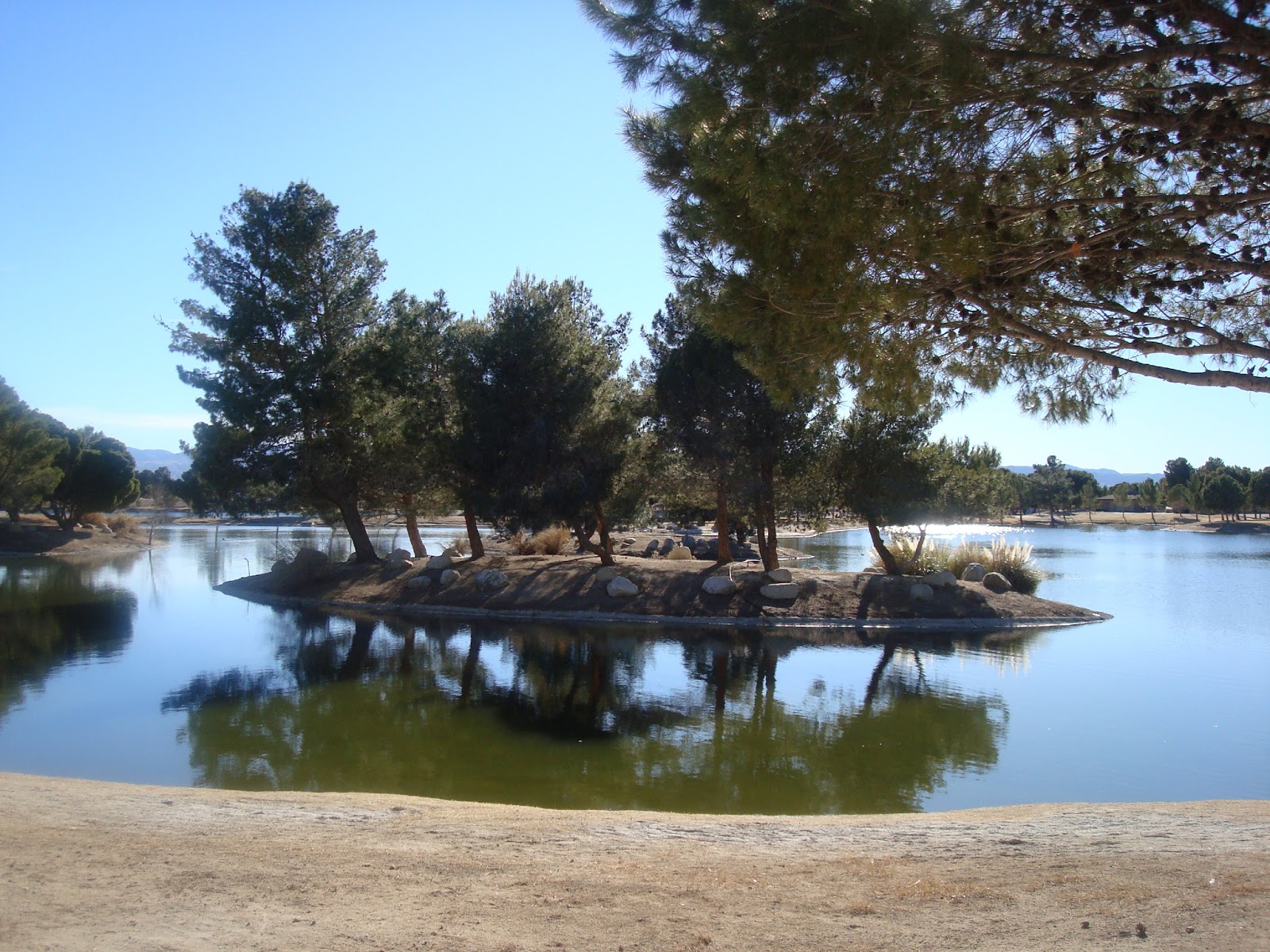
After spending time at the County Library, a pretty nice one with separate bathrooms for adult men and women and children (boys & girls), with no apparent sleeping gestapo (this despite what appeared to be plenty of homeless and services-dependent people and a heavy Sheriff presence sitting in the Central area) and plenty of plug-in space, I went off to Apollo Regional Park near an active airplane field.

The most striking thing upon entrance:  the large number of ducks.  Lots of people liked to feed them;  made me wonder about why people can easily feed these animals for recreation but not other humans.


The scenery seemed to be all designed for lascivious picture-takers like me.


I came away from the Antelope Valley and the 50 miles that separates it from what I call "civilization" for once thinking, "that wasn't so bad."