Showing posts with label Workings of Race/Ethnicity/Class/Gender/Age/Size/Body Mobility. Show all posts

Things Kids Are Doing and Saying Because of...Trump

It's beginning.

I come from the view that everything Trump said during his campaign was a "dog whistle" to supporters to come out of the woodwork and declare their bits of white supremacy and separatism.  

His racist and the support from white supremacist groups are documented and were just non-negotiable for me because it's just a stance that not only he, but ordinary people will feel comfortable in going to antagonize certain groups of people just because of their perceived identities. 

I've been followed conversations on my online community of choice (an NBA team's message board) to get some kind of pulse on feelings of the election.  It's not a representative sample by any means, but I feel like since I "know" the posters in some manner I can learn a lot more.  For the most part, it's not like the snarky world of Facebook, Reddit, or newspaper commenting --- there's a lot more chance for civility and thus, depth in any given discussion.

There were a bunch of these reasonable discussants discussing how "racism had nothing to do with the outcome of the election."

What one (respected) poster actually said was this:  

This election had a race based component, but that isn't what flipped it. As I have been saying, what flipped this election was a number of democratic strongholds that strongly went for Obama (meaning they aren't racist) switching to go for Trump. It was largely economic based.

Instead of having a discussion about the real why's and policy directions, we have this constant discussion about racism that had virtually nothing to do with the outcome of the election.
The guy didn't vote for Trump (Johnson) and is very sharp when discussing trade and economics.

However, I was still a bit unnerved by the last sentence because I don't think it's accurate at all.

I understand that quite a few Democratic Trump voters went to Trump based on what they thought he could do for the economy (or maybe because of the prospect of locking a person whom they were made to believe belonged in prison;  re:  Hilary for prison), but he'd made a lot of noise in his media coverage about banning Muslims, calling Mexican rapists, building walls to keep out said rapists.

For a lot of people like me, that noise was as I said, 'non-negotiable', but I guess for some people the vitriol towards Muslims and Mexicans was something they could tolerate compromise on, as long as it meant a different economic prosperity and/or an "end to corruption."

And now for some instant reaction, we go to America's classrooms. 

1.  Today, my wife told me about how one of her co-worker's sons, a third grader, a 9-year old Mexican-American kid, received a letter from a friend.  The friend, saddened, wrote, "I'm sorry you have to go back to Mexico."  The son was freaked out, and his mother had to reassure him that he belonged here.

2.  Middle-schoolers in Michigan chanting "build the wall."

3)  Shitload of shit:  Trump! being written on a prayer room door, Graffiti reading Whites Only, Car being stolen from a Muslim student, graffiti written that neither black lives nor black votes matter, Nazi graffiti found in the city of brotherly love, a black doll being hung, a man yanking off a hijab, deportation letters being passed out at a school

Stores I Can Only Find in "Certain" Areas of Town (Special Santa Barbara Edition)


I have been working in the Santa Barbara for a few weeks now.

On the night that I was (superstititiously) following the Cubs (in my car in the motel parking lot using Facetime with the wife who showed me our TV screen after deciding that watching the TV in the hotel room was bad luck after turning on the TV to see Aroldis Chapman give up the 2-run home run to Rajai Davis to make it 6-6)  welcome their first World Series victory, the first thing I did was converse with my motel neighbors who had seen and possibly heard me react to every little event.

Turns out that they were from LA too, the San Fernando Valley specifically.  They too were here for work.  They do/did floors.  They’d been in Santa Barbara for months, commuting home to LA every Friday.

After trading talks about me being Filipino, them being Mexican, being married to a Mexican, me being born in Chicago, one of them actually living in Chicago, me living in Compton, them living in San Fernando, they asked me about where they could find a few stores.

Like a…

Home Depot.

Lowe’s.

Food4Less.

99 Cents Store?


My work area having been more towards Goleta, I wasn’t sure where I could direct them (though on reflection there is an Orchard Supply Store on the Fairview exit in Goleta).  Stores that I also gravitate towards and have lived on.

Not being able to find these stores within Santa Barbara didn’t surprise me at all.  I joked that they would have to drive all the way to Oxnard to find those stores.  We all had this somewhat implicit awareness of class and race associations with various brands.

They had searched for these stores, turns out that there was a Home Depot on Calle Real, though about 6 miles South from the Motel we were staying at, around Exit 101 on the 101 Freeway.

Even Autozone is coded as something associated with being Brown and working class.  I don’t find them in Beverly Hills, but I sure as hell find them in Compton.

I needed coolant/antifreeze for my car whose engine thermometer was scarily reaching an unsafe level while I slowed to 40 on the freeway.  I don’t know a ton about cars, but I know that I just wanted the Autozone brand because it had been the only coolant that I used.

I asked the local Santa Barbaran whom I was training, just where I could find an Autozone.  He is a recent college grad who looks and talks like any other white guy, but apparently has some kind of Hispanic in him.  

He knew of an O'Reilly's (which I know is around in Compton), but for Autozone, I searched the phone and found something in Santa Barbara.  

He asked what area.  

I showed him my phone.

He said, "is that downtown?"

I said I don't know.

He took a closer look.  He said, "Oh yeahhh..."  He knew what part of town it was.

I took a closer look.  It said, "East Side."  

Guess I'd located the part of town to get the good stuff cheap. 

The Different Ways I've Initially Described Compton to Different People, and Their Initial Reactionss

We talk differently to people depending on circumstances, and how we anticipate they'll respond to us. 

With the way Compton has received an infusion of cultural capital in the past year because of the movie re-hashing NWA's rise and fall and Kendrick Lamar everything, you'd think it'd always be something to proudly declare, but not always so, particularly with people I don't know. 

Generally in everyday conversation with acquaintances and people I don't immediately know, I try to show "alignment."  That is, I just try to see where they're coming from and then "show" how similar I am to them. 

With "people whom I've met only briefly", the conversation is all about getting to know a person, and "where I live" would be a primary question.

By "showing alignment", I am likely not going to mention that I am from Compton, unless they ask, but in a way that doesn't seem like they'd think any less of me and/or disregard any of my future opinions. 

For example, when meeting new people, for me it's really difficult to tell white people who are generations before me because either they are outside of California and do not know the reference to Compton, they are from California and are probably likely to associate Compton with negativity.

In contrast, "people with whom I am in regular contact", we have an established certain pattern of interacting.  Were beyond introductions and more about talking about whatever we've established talking about and updating each other on aspects of our lives.  "Where I live" would usually be a question embedded within an established history of conversation.

So, here's a sampling of different people I've encountered over the past three years, their demographics, the circumstance in which I've introduced my town, and my relation to them divided by race.  I divide on race, because in one-to-one interaction, it is the one attribute you can't really do anything to hide unless you're talking to a room of blind.

I don't think that we are inherently "different" as peoples of different races.  I don't think "white people are a certain way, black people are a certain way etc.", but depending on your race (as well as class-gender-ethnicity-etc.), you will have associations, knowledges, and behaviors ascribed to your race.  We as humans all carry very arbitrary, imperfect associations, knowledges, and behaviors of different races and ethnicities.

As you will read, those associations, knowledges, and behaviors constrain how both any given individual views and is viewed.  


TO WHITE PEOPLE WITH WHOM I AM IN REGULAR CONTACT (OR USED TO BE):   With these older people, I haven't really talked about where I live.  I avoid it, or were too deep into the relationship talking about other things that where I live hasn't come up.  With younger folks, I talk about it and it's not an issue after that.

To a blue-collar male co-worker in his mid-50s living in Orange County:  I wrote about this guy here.  Though I've developed a pretty good working relationship with him, I still avoid the topic as much as possible.  I have not mentioned at all that I live in Compton.  He thinks that I live in Long Beach, because I'd mentioned that I was "still" in Long Beach when I was running late one day.

To a college-educated male co-worker in his mid-50s formerly living in Culver City:  Unlike the guy above, I would actually talk to this guy.  He'd even met my wife and has seen my baby.  He would talk about old Los Angeles, things he'd done on our job around LA, and trips he'd taken across the country and abroad.  I never mentioned living in Compton, but it wasn't because I did not want to tell him;  the topic just never came up.


To a graduate-school educated male lawyer in his mid-30s living in New England:   Last time I saw this guy was my wedding.  I warned him, told him, he drove in with his wife.  Great times had.


To a some college female co-worker in her 40s-50s living in West Covina:  I trained this person on a project.  She was friendly and asked about my baby.  I met her for the first time right after the shootings in San Bernardino and she said that she had ties to the facility.  I was trying to feel her out based on how she was reacting.  She never really asked so I never mentioned that I live in Compton. 

To a some college male co-worker in his mid-20s living in Venice:  This guy I'd actually consider my friend.  I actually had him visit the house in Compton, on a Friday night.  The first thing he did was call his brother and ask him, "hey guess where I am?"


 TO WHITE PEOPLE WHOM I'VE MET ONLY BRIEFLY:  I'm very guarded against older white people and try to get a feel for their political leanings.  With younger people, I usually just try to lay cultural references thick on the "millennials."

To a college-educated female "co-worker" in her early 30s visiting from Washington, DC:  She was there to observe me for a job, specifically for jobs in Compton.  I told her that we'd be visiting the area.  She seemed somewhat indifferent even as I was trying to make the rap references which seemed only vaguely familiar to her.  She had the company-rented car and didn't mind leaving her car in a Compton neighborhood, a very suburban-Lakewood-ish-appearing area south of Rosecrans on the West side.

To a some college immigrant realtor in her 50s living in Upland:  She was curious about the job I was doing.  I explained my job.  We got into a deeper conversation about children as she was carting around her grandson. 

I initially told her I live in "Los Angeles."  As the conversation snowballed and knowing her realtor sensibilities, I got comfortable enough to reveal that my wife.  As I expected, she remarked that "buying" and "owning" is better than renting.

TO BLACK PEOPLE WITH WHOM I AM IN CONTACT REGULARLY (OR USED TO BE)
By "black people", I mean "black Americans."  Black Americans usually know what Compton is and what it means.  Despite living in Compton, I don't run across many from outside who would really question the experience.  I think I garner more of an "oh really?  Cool"  sentiment from the very few that I know.


To a college-educated male former roommate and postman in his early 40s living in Long Beach:  This guy was a transplant from the Midwest, whom I described on my former other blog.  When I first told him bout my new digs in Compton, he told me to invite him over.


To a college-educated female birthing midwife in her late 40s-early 50s living in Upland:   We told her kind of hesitantly that we lived in Compton, attempting to hint at the fact that it was a more Latino neighborhood in which there had been a hate crime.  She responded in a way that said, "really, you think I'd be scared of Compton?"


TO ASIAN PEOPLE WITH WHOM I AM IN CONTACT REGULARLY (OR USED TO BE):  This is pretty much family members and friends, so on one hand, I know they're supportive, but sometimes they might drop subtle cues.  Also, since they're family and friends, I likely told them some two years ago in 2013-2014.

To a college-educated female immigrant nurse in her early 60s living in Santa Clarita:  This is one of the aunties from my mom's class who seems to like me a lot.  She actually visited me one time.


To a college-educated female nurse in her early 30s living Culver City:  I went to grade school with her, she was a year behind me.  We both ended up graduating from the same college, though I transferred from Slug Nation.  She's a nurse now, and is still close to one of my close family friends.  When I told her that we were living in Compton, she asked, "straight up?"  The kicker is that she is going to marry a guy with whom I went to high school with and also was a year behind me, and also ended up at the same college.  So I had to explain further, "yeah, it's the cheapest place to buy a house!"

To a college-educated female teacher in her early 30s living in Eagle Rock:  This is the "close family friend" whom I mentioned in the synopsis previous to this one.  She's been more like an older sister.  She was supportive, after all she'd worked very close to the area.  Though she did wonder, if I'd ever be able to sell the house that we'd bought.

To a college-educated male counselor in his early 30s living in the San Fernando Valley:  This is my best man.  He's a big fan of the wire and hip-hop, and especially Kendrick Lamar.  I try to let him know about significant locations here.

To a college-educated male engineer in his early 30s living in Orange County:  One of my groomsmen whom I've grown up with and told to visit, but he hasn't visited.  But I think it's mostly because he's busy.

A graduate school educated female pharmacist in her early 30s living in West Covina and a graduate school educated counselor in her her early 30s living in Pasadena:  I remember the conversation when I revealed to her and another friend that we were living in a house.  I came off already apologizing for our location.  I said something like "It's Compton, but..."  They replied at different times saying essentially, "...but it's a house!"


TO ASIAN PEOPLE WHOM I'VE ONLY MET BRIEFLY:  Like with older white people, I also am guarded and try to get a quick read on their political leanings.

To a blue-collar male welder in his late 60s living in Torrance:  I met this guy while on a job in a beach city.  He was seeing me doing my job, and was bragging at how he had been a veteran, and for a long-time an expert welder.  He talked about his trips to different places.  He encouraged me to go to school for welding at El Camino College so I could "better myself."  I did not mention the city I live in to him.   

To a college graduate female graduate student in her mid 20s living in LA:  I met this girl while doing a big project.  We found similar academic interests.  She was from San Jose.  I was kinda trying to get a feel for how she'd react but I let out that I live in Compton...but for economic reasons.  She appeared to show alignment and understanding of my reasoning.

TO LATINO PEOPLE WITH WHOM I AM IN CONTACT REGULARLY (OR USED TO BE):  Similar to the situation with black folk, I don't really have any issues telling any of them regardless of education, class, gender, or age that I'm from Compton.  Usually I can joke with them about it, and/or comfortably invite them over with no issues.

To a blue-collar male co-worker in his early 30s living in South LA:  Dude I'd consider the homey.  He regularly comes to drop work off.  He even has a girlfriend in the area.

To a blue-collar male co-worker in his early 30s living in East LA:  Dude I'd consider the homey.  He doesn't come to drop work off.  We still joke a bit. 


To a blue-collar male barber in his early 70s living in Gardena:  This guy's my barber.  He collects clocks and stuff from the '50s, which is displayed prominently all over his barber shop.  I only recently started really getting close with him after my 3rd or 4th haircut, especially after I found that he's actually Mexican (thought he was some Italian guy from New York), and after a roving vendor with socks tried to sell me socks and called me a "verga" for pretending to be interested, when I was just trying to be nice.  Anyhoo, I didn't really have much issue telling him that I was living in Compton.  He told me he was from Watts, and the conversation went on and on from there.

To a some college female immigrant superior in her early 30s living in West Covina:  Now this person is kind of my boss, but she's pretty cool.  After a few projects under our belt, we've developed a pretty close working relationship.  Our conversations are really always about work, but sometimes we deviate and talk about our families.  I'd never really mentioned the city to her, except for job purposes.  I don't really talk about it because I don't know how familiar she would be with any of the cultural references.

TO LATINO PEOPLE I'VE ONLY MET BRIEFLY 

To a blue-collar male in his mid 20s living in South LA:  I was working with this guy who had some punk rock T-shirt on all the time and was supposed to work with the company.  He told me that he lived in South LA.  I told him I lived up the street. 

The Problem With "If You See Something, Say Something": The Inevitable Selective Application of It After The San Bernardino Shooting

First off, on the shootings in general. As the father to a 9-month old, I can't understand how anything could drive you to commit an action that would take you away from an offspring.  I don't care to judge, but all I'm saying is these actions are infathomable and overwhelmingly tragic.  But yeah.  Damn.  Fuck.

After the mass shooting in San Bernardino, law enforcement has aggressively encouraged the public with a sign I've seen at Disney Studios in Burbank "if you see something, say something."  I generally don't have a problem with that as a general idea applied to any situation. Its a constant reminder, and upon seeing it, people will always be on the look out in general.  

But the mass call by law enforcement in the context of just this shooting bugs me a little bit.

Only in this shooting, out of the 350 or so this year, have I seen/heard law enforcement, people more aggressively say, "if you see something, say something."  The more 'radicalized' conservative version of people commenting on this situation is people saying "I don't care if I offend Muslims, let's profile the crap out of them!"  Meanwhile, we'll still have about 348 of those other mass shootings. 

The fact that law enforcement is more vocal to "see something, say something" particularly around this shooting involving Muslims is that now your right-wing radical as well as your average moderate will wonder a lot more about the Arabic, Middle-Eastern-ish garb-wearing people for nothing other than the way they look and dress.  I say "Middle-Eastern-ish" because just as after 9/11 we saw idiots harrass Sikhs for the headscarf, they will probably do the same. 

The fact that the San Bernardino shooter has been constantly described as "quiet", that co-workers couldn't remember any conflicts, and that even his own family didn't suspect anything, gives those who want to "see something, say something" even more reason to scrutinize anything they associate to be "Muslim" to the exclusion of any other person who also may be doing something suspicious. 


Yes, the LA Media Did/Has Ignored the Beirut Bombings

At least the media, I listened to and watched.

The media which I actually generally like and trust.

There's an article written on Vox, "Did the media ignore the Beirut bombings?  Or did the media?"

The author says that "the media has covered [the Beirut bombings] extensively."

That only true if you have access to the internet AND know/knew where to look.  The majority of what he cites are online publications, with the exception of CNN, which I don't have.

I wouldn't have had access to that knowledge if all I had was local FM radio and TV.

There are days when I'm on the internet all day, and get news really quickly thanks to Twitter, but that's not often.

On November 12 and November 13th, a Thursday and a Friday, I wasn't on the internet all day, so I was mostly getting news from radio and TV.

I was in the car listening to 89.3 KPCC around 1 PM, November 13th. 

The BBC Newshour just began reporting about the attacks on Paris.

The severity and importance of the attacks didn't hit me until the coverage of the attacks bled over onto the next news hour during The World, and then onto All Things Considered.  It was only after that continuous coverage that I got the idea, "oh shit, it's their 9/11."

Once I got home at around 6 PM, my wife was watching the KNBC News, incidentally KPCC's media partner. 

My wife, also a KPCC listener, asked me, "did something happen in France?"

I said something to the effect of :yes, a few shootings."  We watched NBC for more details.  It was all jarring.

Leading up to this day, on Thursday, also in the car, all I could recall on KPCC was talk about the protests happening on campuses and the Officer Involved shootings in LA County, both important issues here. 

But there was no continuous updating by the BBC nor The World nor All Things Considered.  It was just a normal day, KPCC bringing up very interesting issues, but no alarm bells ringing.

I didn't have awareness of the Beirut bombings that had actually preceded the Paris bombings until Sunday morning while browsing Twitter and being curious about what Muslims had to say about the Paris bombings.  I ended up re-tweeting what they said.

One of the Muslim Tweeters posted a link to the New York Times' story about the bombings in Beirut.

This past Monday, November 16th, I watched a little more of my local news on NBC.  They made mention about progress on the investigations of the bombers in Paris.  I go to the Today Show news website.  Still no mention of Beirut.  I go to the NBC News website, the World Section.  Plenty of articles pertaining to the Paris Terror Attacks.  Not one of Beirut.


Acknowledging the Unacknowledged on Veteran's Day in LA

Just as every year on TV, they appear to focus on white American Veteran stories (props to Google for their multi-colored Vet Day logo), my focus is on unacknowledged soldiers.


On this day every year, I remember Filipino American Veterans from World War II.  I have been for just about 10 or 11 years now.

'Unacknowledged', 'unrecognized,' are the operative adjectives.  Unacknowledged by major media outlets (and by proxy the American public), unrecognized by US government agency, until relatively recently.  

Basically, when we were at war with Japan, Roosevelt offered soldiers in the Phillippines the same rights and benefits conferred to American soldiers so that they could help in the US effort.  Then, as soon as we won the war, Harry Truman, signed the Rescission act of 1946.  The Rescission Act stripped them of any benefits that they were due to receive.

Just as Veterans from World War II die every year, Filipino veterans from that era die increasingly every year.  

They have been fighting for their rights since the 1960s, and have only won what little recognition and rights in piecemeal fashion.  

For the Fil-Am veterans living here in Los Angeles, a few in Historic Filipinotown, they've scored a few minor victories along the way, such as a little statue at Lake St. Park, installed in 2006.
 
Their largest, and most recent victory nationally was a one-time lump sum payment in 2009, which needed to be bundled under Obama's Stimulus Act from his first term.  But obviously that one-time lump sum payment was a compromise meant to address part of the injustice, and not the full extent of the injustice.

I just wonder what "could have been" if these Filipinos were able to build their lives here, with the benefits of home ownership, the GI Bill, etc.  

I mean, I'm here, I'm sort of successful, but maybe more capital could've been sent to the Philippines, and they'd be more well-off.  Its all been lost time now, but I don't think addressing the injustice is over.  

The group that I usually hang around with, Justice for Filipino American Veterans (JFAV) held a march today in Hollywood, and for more than 15 years have been focusing on getting WWII Veterans full recognition.  I didn't attend and I guess I should have, but the logistics of making it all happen today with all the responsibilities, and the fact that my main computer went down made that a non-reality.

Happy Veteran's Day, and till justice is served....

Complaining: A Poor Verb to Describe Student Reporting of Racist Incidents Such as #ConcernedStudent1950 in Missouri

I've always been interested in language thanks to George Lakoff's Metaphors We Live By.  One of Lakoff's interests is and has been "framing," or basically how something, be it a news item, a candidate, is presented.

One ESPN article covering the firing of a University President over racial tension at his university seemed to be emblematic of poorly built framing that bothers me a lot. 

The "framing" essentially presents the students in "complain" mode. 

"Complain" especially in the American context always carries with it a negative connotation.  The common belief, built up by an endless array of narratives from media, school, places of business, work is that you're not supposed to do it, much if at all.  The American narrative is supposed to be about working, working, working, no complaining.  Or if you want to complain move to a different country.

In the article editor/writer uses the word "complaint" in a headline link. 


S/he uses variations of the word (i.e. complaints, complained) three more times in the article all to describe actions that students and students alone took or have taken.  We read all about students and the flurry of activity that they have taken, couched on variants of the word "complain."

The student groups are complaining about "racial slurs" and "slights," terms which make it seem like students are simply getting mad over comments made to them.  Lots of commenters say some variation of "they've got some soft skin."

We don't get much sense of why the students are taking such action.  The depth of the reasons for doing so are buried at the bottom of the article,  in terse sentences. 

The article makes almost casual mention of four separate occurrences that have sparked these protests, each of which have only one sentence describing them.  Two of the occurrences are even peppered with a sprinkle of doubt with an "apparently drunken white student" and "two trucks flying Confederate flags, a move many saw as an 'attempt' at intimidation."

One of the occurrences includes feces being smeared in the form of a Swastika in a dorm bathroom.  Typical good ole boy college humor right?


We don't really read much about the President and his inactivity, except his credentials, and the one time where he does not choose to speak to students.  His refusal seems casual. At best he's painted as a typical busy, dismissive university administrator riding a limo who was the unlucky one to lose his job, which leads to comments such as "Another case of inmates running the asylum." 

If ESPN really want to ramp up the hits, their headline should've just read, "Unlucky white guy loses job to complaining blackies."

How Would They Describe Student Actions Then If They Are Not "Complaining" or Filing "Complaints"?

The article is anything but netural.  I probably wouldn't write like whoever did this.

I'm not saying that they shouldn't ever use the word "complain", but in this article and context, it's flagrant. 

With overuse of the word "complain" combined with a dismissal of the occurrences as "slurs" and "slights, they've painted the students as overly-sensitive if not overly emotional.  It's hard to see the students as anything but overly-sensitive and overly emotional, unless you are black.

I mean, ESPN could have painted the student groups as somewhat "reasonable" side by using the word "cite" as in "black student groups have cited incidents etc. etc.", but it doesn't seem like that was ever in this writer/editor's MO.  

Microaggressive Racism/Classism on the Wesside?

About a month ago, KPCC, hosted a talk at UC-Irvine about microaggressions, which is surprising, because it's an academic topic which has now become a largely misunderstood public topic. 

When I attended the talk, I thought the examples given of microaggression at work were kind of weak because they lacked any context.  One example that I thought was weak and hurt public understanding of microaggressions, "people asking an individual "where are you from?" 

Today, I think I have better examples.

Today, I went to buy the kid a very expensive 1st Birthday cake. 

For that we had to trek all the way up to the Little Ethiopia in West LA, which is actually very close to the office where my sister and I work. 

On the way there, we had to find parking in the neighborhood on Whitworth Street.

I know this neighborhood sort of well;  the kind that does not want outsiders to infiltrate their parking spaces.  They have three different types of parking signs per post --- one telling you that you cannot park there from 6PM to 8AM, one telling you that anytime after 8AM or before 6PM is only for 2 hours, and that if you have a district sticker, these signs don't apply to you.

Now, I like to think of myself as an Anthropologist who notices racism when it happens, but I guess I miss a lot of subtle cues, according to my wife.

My wife is from Wilmington, CA and grew up in and around Mexicans and blacks.  She tells me that going to get her MA at Loyola Marymount with white kids was kind of a culture shock for her. 

I've grown up in and around public spaces with white people.  It was kind of a status thing within the Filipino kids and parents to say that I was going to private school with the white kids, the Loyola that is an all-boys high school. 

I think my wife picks up some cues that are not there sometimes, but then other times she's dead on about what she notices.

She's told me about child-adult-hoods of being followed while at stores, or people acting suspiciously around her. 

She's not even necessarily into race and ethnicity scholarship like I am, but she has a keen awareness of her settings and the social perceptions that surround her.

Today, she noticed two things that I completely missed.

1)  As we got out of our car after changing our son's diaper, we headed north towards a sidewalk across from us to go left. 

Another couple, taller, whiter (probably judged to be better looking by industry standards) with a younger baby in a stroller, heading south on the sidewalk was headed our same direction.  I was carrying our baby over my shoulder.

According to my wife, they walked, and were initially ahead of us, but they let us pass.

I did not think anything of it.  I just thought they let us get ahead.

She thought they might have thought we were suspicious and let us go ahead.

2)  On our way back from the cake shop, we walked back to our car. 

On the phone, I heard some guy talking loud.  It's like he was almost yelling at the phone.

I had some inkling of a feeling that we were being watched, but I couldn't pinpoint exactly where. 

My wife brought it up later, and it's funny, that was kind of suspicious too.

We don't know the intent of any of these individuals, but if my wife perceives a slight, then I generally trust her judgment mostly because she tends not to complain about strangers she does not know.

This doesn't really take away anything from us, but it does make us reflect on "our place" in society.  As both educated professionals (or sort of professionals in my case), both of us know we belong and can hang, but it's this type of thing that subtly communicated to us in our younger years that we could not and did not quite belong with rich white people.

Working with a Baby Boom Generation Speed Demon Somewhat Talented, Donald Trump-Voting Co-Worker Who Kinda Promotes Racism: A Case Study Reflection

I Stayed Silent.

If there's one thing I learned in working with someone who casually promotes racism, it's a lot easier to shout some anonymous person online down.  It's easier to draw lines, pick sides, call names.

It is much harder to confront someone you know and developed some kind of rapport with.

I worked closely with a white American dude old enough to be my father.  He said lots of racist stuff.  I survived.  But I always knew I wasn't going to melt down or mentally crumble the way a racist person might think.

Having progressive beliefs and friends around me, the expectation I had of myself, and progressive friends might have of me is that I'd probably confront him about his racist speech.

But I don't like confrontation, I'd rather do everything to avoid it.   I also had a curiosity to know how our relationship would keep evolving without using that racism to shut down any contact and thus, never be able to get to know him and write what I'm currently writing.

So I just kept plugging away at our job.  I'm just here to get my money and get out, I thought.

I stayed dead silent and chose to avoid commenting when he would say "Asians this...", "Mexicans that...", "Muslims that..."

To be clear, I'm not calling my co-worker a "racist", as if being a racist was a separate species of human.  I'm telling you that he does what he does;  he kinda promotes attitudes of racism.  By "racism", I don't mean the separationist, KKK-rally attending view of a "racist", but rather a more "casual" racist. 

It's not like he consciously avoided people of color or anything associated with them --- he was born in Japan, he drove a Nissan, he ate burritos with me.  He talked about his sexcapades in foreign lands.

It was more like when someone from another race did something that got in his way, he would insult them based on whatever was a trait that stood out. 

Being in Southern California, people of different races is the norm, and so if he saw any hint of brown at a person who just happened to get in his way he would say, "Muslims that, Mexicans that, Indian chick, terrorism...etc." 

The First Time

I remember one particular moment when a elderly Japanese man was driving a truck, and making a right turn.  He did it slowly.  But we were trying to make a left into the same street before traffic came.  He exclaimed, "Come on you fucking Jap, hurry up.  That's why these people shouldn't drive."

I was floored the first time he made a comment like this because well I guess I'm just not used to it;  and it's something I would not want to get used to.  I was kind of paralyzed in action, but I realized the old engineer's principle, "if you don't know what to do, don't do anything."

A lot of his rage was channeled on these within-the-moment occurrences, but he moved on kind of quickly afterwards, with the exception of an extended conversation monologue about how Donald Trump was "the guy to get shit done." 
 
He didn't dwell on and on about other races and ethnicities;  but perhaps it's because I did not join in any of his tantrums and I made the conscious effort to stay silent during them. 

I wonder if his many many white working buddies from yore would probably go on and on about different races and ethnicities. 

I myself am not actually white.  I guess I can look somewhat culturally ambiguous, though the guesses usually only range from Asian to Hispanic.  I don't know if he ever figured out that I am actually Asian or specifically of immigrant parents from the Philippines.  It seems like he thought I was Mexican, but when he saw a Mexican guy in a civic was speeding on a residential street it never stopped him from talking about "its always these fucking Mexican kids speeding."
   
Donald Trump:  A Gateway to Openly Expressing Racism 

The first time I recall him making any kind of incendiary commentary, it was related to Obama.

I did vote for Obama, and I think he's doing great, but I don't necessarily support/condone everything he does.

When in conversation about Obama, I know that the best thing is usually to remain silent.  I've seen enough online commentary to know that minds are made up about him, way before any conversation takes place.  Trying to change anyone's mind about Obama is like trying to change someone's religion.

When my co-worker made his comment, I was making comments about the dangers of the particular job we were doing without the benefit of construction zone cones or a full work crew.  Our job on that particular day included standing in the middle of the street, sometimes getting caught up morning rush hour traffic on 50 MPH speed limit streets. 

"Sometimes, maybe this job isn't worth it," I said. 

He said, "I'm only risking my life if I'm taking out Obama."

It was mostly a political statement, but a bit unsettling to invoke a fantasy of presidential assassination while in the middle of a job.  It made me wonder if he would have said the same thing about George W. or even Bill Clinton.

In our first few months working together, he was one to make a lot of political commentary.  He told me that Fox News was the only news channel worth listening to.  He was also trying to talk about how Donald Trump was going to change this country.

Along with his political commentary, in part, poetically mirroring the seemingly unfiltered Trump, he began to openly channel some pent-up anger against some of these groups.

I think it took a kind of comfort level with me for him to begin even making these type of statements.  Again, I dislike confrontation, but I guess that dislike makes me a natural for Anthropology where the main task is to listen.  I'm always curious to know what people are like in their "natural" state.  That is, I like to see how people are when they're not always confronted or being asked to change.

A Quick Humanizing Biography According to My Point of View

Aside from the racism, there was a lot I learned from him and actually admire about him. 

I think everyone is bound to have redeeming qualities.

He's not the worst person in the world, but you wouldn't easily warm up to him.

We worked early, and he was just about on time every time. 

He listens to the soul, jazz station 94.7, the Wave and alternates with 95.5 KLOS, classic rock.  It seems like he would put it on 94.7 whenever I was in the car.  I was actually kind of shocked that he listened to the Wave, and with great enthusiasm.  One of my co-workers suspected that he had been in an interracial marriage because of that, incidentally.

He calls and prides himself as a "speed demon;"  he is reliably, almost unfailingly so and efficient at the job he is called to do.  He gets things done and does a great job of planning ahead, but you will be working fast.

Anything involving work productivity, I believe he has great knowledge and can get done.  Build a house, fix a car,  cook, garden.

Though once you walk him into the realm of dealing with computers, all you see is another bumbling old guy who says he gets it, but does not actually. 

So while we were getting our work done, he often left any computer work related to uploading or downloading to me or another co-worker.

Being of the late Baby Boom Generation, he was one to reminisce on his days as a young iron worker.  He needed to be quick and tough.  He prided himself on landing a position in management fairly quickly.

He follows sports, but only to bet and win money on golfers and baseball teams he bets on.  He actually got me into golf, which incidentally got me watching/following Filipino-Aussie Jason Day.

In the short time that he was with our company, he's quickly developed a reputation for being fast and efficient, but being difficult to work with.  Being difficult to work with didn't necessarily mean that it was because he was being outwardly prejudiced or anything, it was because his working style is fairly rigid and inflexible. 

At the beginning of the project, when there were multiple people, we tentatively agreed to meet at 6AM.  For these projects, the norm had been to meet at 6AM for the first few weeks, but then adapt the schedule as necessary.  He's the only one who'd adhere to starting right at 6AM every day. 

The fact that he worked on that schedule, also while noting when co-workers were not available or missed something while on assignment rubbed more than one of my co-workers the wrong way. 

I could see why the co-workers disliked this;  he was making himself look good, while kinda making the others look bad.


When I See Him Again

He may read this some day, and so I've written this piece with that in mind. 

There were times where we felt really good about finishing things.  Like the time, we finished surveying street lines.  While in a strip mall, he turned up the volume on 94.7 and rocked the block.

When we were focused on the job and finishing things, all was good.

But every now and then, he would say something that would remind me why I couldn't quite feel really comfortable around him.

He would continue to make his comments about Asian drivers, Mexicans, etc.

A lot of his politically-tinged commentaries also centered around "bringing the America he knew back."  When we saw a rocket ship in a local playground, what they call "Cold War Playground Equipment", he lamented the fact that America was becoming too politically correct.

That kinda statement seems to reflect his internal "need" to continually make offensive comments about other races and ethnicities.

But he took me aback when we were talking about his favored physiques for women.  Somehow we got to talking about Serena Williams.  He thought the typical bro thing, "she looks like a man." 

Arguing over personal tastes, I've figured, is usually a lot less tense than arguing politics of right and wrong, but it is still a way of communicating politics, and, so I bit.

"I kinda like the Serena Williams body type."  Which, incidentally, I actually do.

He more or less accepted it, essentially saying to each his own, which in his case tends to be the classic petite women, and encompasses a lot of Asian women.

A few days later while on the street a carrier truck apparently being driven by a black woman was speeding through the fast lane on a 4-lane street.  My co-worker wasn't in too much danger, but it kind of shook him up a bit.

I remarked that it was "Serena Williams trying to get some revenge," to which he said, "probably one of those Fergusons."

"Fergusons?", I knew exactly what he might be aiming for when he said that, but wanted to hear him explain it all himself.

"Think about what happened!", he implored me to think. 

I already knew.

He said, "it's my new way of saying nigger.  You can't say that anymore.  I told the black guys at the golf club and they laughed."

Oh.

Thinking About Why Gang Tagging Still Exists on My Block

It's been another long summer, which on our block means one thing:  tagging on the walls!
And it's not just some crews interested in tagging or doing artistic murals or anything --- it's gang tags, or kids representing a gang that has existed since the 1950s.

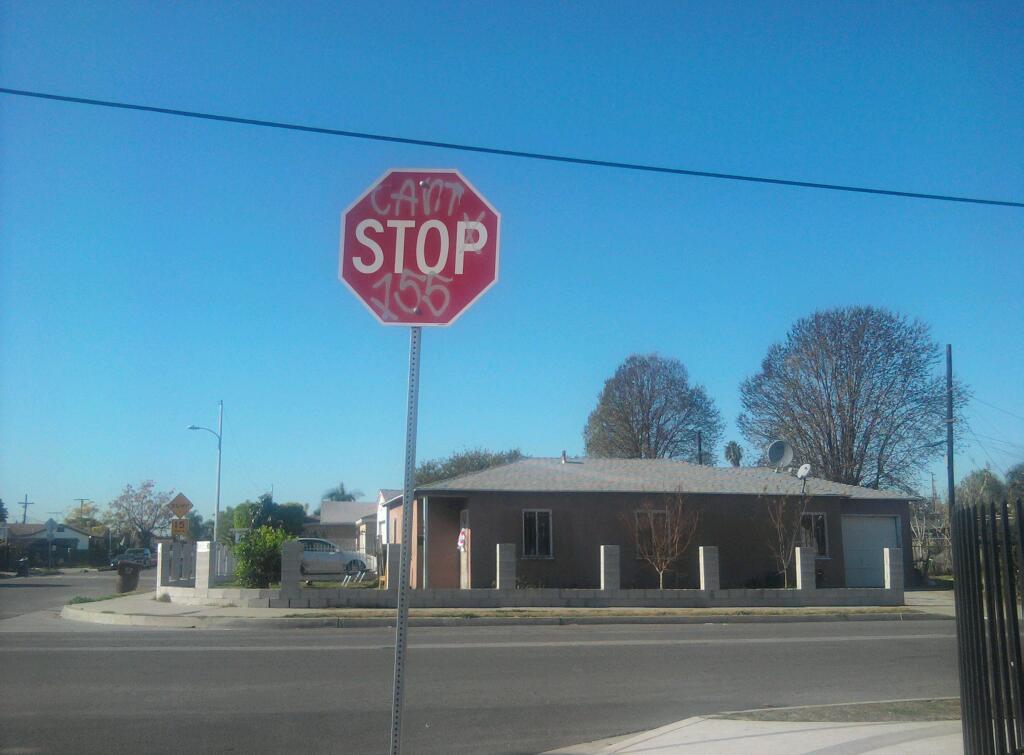
On Stop signs, you will see a "CANT" scribbled on top and below the "STOP", you will see the gang's name scribbled underneath, so that Stop Signs around the area read "Can't Stop [Gang Name here]"


This morning, I watched the graffiti team sandblast the gang-tagged walls along the street for probably it's thousandth time.  It's the end of July but it's the first time I've seen them all Summer.

Its the first Summer where I've lived here and seen another gang combat the dominant one here.


The tagging has been a persistent nuisance, but I am told by neighbors who have lived here for 20+ years that there was a time when the sandblasters would be painting a wall and a tagger would be right behind them throwing up a tag just minutes after they had finished sandblasting the ball.

That's not the situation now.

But the Summer is when school is out.  Presumably school kids are keeping the wall plastered with their hastily spray-painted insignias representing their gang.

My most immediate neighbors call the current crop of gang taggers "remnants" or "knuckleheads";  the ones who caused all the trouble in the 70s, 80s, and 90s are either dead or locked up.

I don't know any of the kids currently doing any of the tagging, but I was thinking deeply about why these kids (I presume that they have to be kids) felt such a need to continue tagging.

I think of Bambu's Old Man Raps.


I think about who in our neighborhood says anything if at all, and how we seem to let the tagging persist.  I am glad that this appears to be the only issue that I see nowadays.

I realize that there are deeper issues than just tagging.

From my point of view, as an unconnected resident, but a kind of academic, I think it all comes down to individuals recognizing their place in the larger society as being permanently marginal.

 'Permanently Marginal' in the sense their place in larger society can't actually change.  But within their own place in society, they will try to make the best out of what they have (or perceive themselves to have).

Drinking, partying, threatening violence is what they have been, and where they will be.  It's kind of immutable facts of life (which I wonder how much has changed in this age of media 2.0 and the omnipresence of the phones).

I try to imagine what materials and resources they own.  I don't imagine most as home-owners, and I think they're barely making it, probably living with family members.

They probably don't own much other than their reputation, threats to violence, and their outward expressions on the wall.  Their showing of vitality is reliant on vandalizing the public spaces.

The moment they let up their claim of our walls, stop signs, etc., public utilities, it's as if they have let others "win" while their gang has "lost."

I think that as long as their youth (and whomever their elders are) frame what they see as "their" walls, stop signs, public utilities as spaces to claim to show their gang's vitality, it will be an ongoing fight.

I just wish they'd take listen to a former gangbanger from Watts and re-direct their energies and vitalities to other life-building pursuits.

The Song that Almost Every Young Black Person on the Metro Green Line Knew

Something general that's always piqued my interest:  where do people get their music?  If not on the radio.

The past few weeks I've been wondering about Boosie Bad Azz.

On the Saturday that I biked to and from Marina Del Rey and ended up taking the Green Line to Avalon station, a young black woman was blasting her music for all Metro's patrons to hear.

Generally, I don't know why or care how people blast their music on the Metro.  Personally I think it's young folk trying to show something to the world, which I have mixed feelings about.

One song came on what appeared to be her Pandora playlist:


Boosie Bad Azz's No Juice.

Almost every young, (non-alternative, hipster) who heard was mouthing the lyrics.

One black dude holding a Madden 15 XBox One cover.  Several dudes who passed by.  Some women.

It was a popping ass song that I had to Shazaam.

Being a fan of rap/hip hop (most prominently of the Mos Def, Roots, Blue Scholars), I'd never heard of the song, which is considered "Dirty South", a sub-genre of rap that I probably I would never run into anyway.  Even if I listened to a Power 106 or KDAY, I don't think that any radio station here would play this.

Basically, it's a song about being real and not lying about how tough you are.

I did a cursory search of the song, and it turns out that Seahawks Running Back and current representation of intolerable/raw blackness Marshawn Lynch made mention of the song during an interview.

Just an everyday curiosity that makes me wonder about people's frame of references, in which music probably plays a big role in establishing or reinforcing an expressed identity. 

How News Media Fosters De-Humanization: A Case Study

First, I genuinely wish the families of Lexi and Lexandra Perez and Andrea Gonzalez prayers, good vibes, and karmic good.  

Rest in peace Lexi, Lexandra, and Andrea. 

I also wish for the same for the man who ran them over and his family.  Most would be understandably mad at him not only for killing, but for also fleeing. 

When these things happen, everyone loses.

Here's to hoping for an evolution into safer streets for everyone.

* * *
 
It was only a matter of time before they located a driver suspected of killed these three trick-or-treating teenagers in Santa Ana.

While it's good news, I was pretty irked by OC Weekly's coverage of this finding.


I wouldn't doubt any of the claims that OC Weekly is making, but it's their emphases that bother me.  Which emphases?  The ones that do more than identify but also further brand this individual as nothing more than guilty criminal before any investigation or trial has been set. 

As someone interested in Linguistic Anthropology, I always wonder how reporters use words to describe their understanding of a situation.  I definitely believe that their own background influences how they see and ultimately represent the background of a victim or an accused criminal.

I tend to think that media, most of whom are white, would be quicker to label a lower-class black guy with a more crystallized "criminal" branding than they are a lower-class white guy.  Possibly out of intent, more likely out of habit.

The basis of the article is the accused and his "long rap sheet." I must admit that I was a little curious as to who he was.  The OC Weekly dug that up, but they only trotted out his criminal record;  who really was he outside of this criminal record?  We don't know anything about his mom, or the two people he was with.  Why would they let him drive?  We don't get that idea whatsoever, and are not really exposed to any other complexity of his life other than the part of his history that notes his criminality.  

The OC Weekly's emphasis on his "rap sheet" only serves to crystallize and make it seem like what he did was ultimately of a permanent, intentional mindset.  I'm not sure why they decided to make his criminal record a "thing of interest," and focus of an article, rather than as simple background and part of a tragic story.  Though I am referencing a different article in a different city with a different writer, when Nathan Louis Campbell apparently rampaged and ran over those pedestrians with his Dodge Avenger at the Venice boardwalk last August and killed the honeymooning Alice Gruppioni from Italy, even he was not saddled with the broad brush of a menacing "rap sheet", he was simply "once locked up for shoplifting" though the article makes mention of another incident.

I am also bothered by OC Weekly's use of the word "homicide" as one of the labels/tags for this story. It's an accident, a distinction that would be of no consolation to anyone, but quite different than "homicide", which is worth noting for a news source purporting to be objective.  He is being charged for manslaughter and fleeing the scene, not homicide or murder.

OC Weekly's emphasis on the rap sheet, combined with this mug shot of yet another black guy in our faces, and the lack of focus on the victims has definitely stirred reaction.  As of this writing, the OC Weekly has reaped the benefits of this reporting with over 144 comments.

OC Weekly's coverage of this case is what I consider the low, dim end of the spectrum.

In my anecdotal scan of the coverage of other vehicular manslaughters in LA and OC, no one has really cared to splay an accused driver's criminal history or "rap sheet."  It didn't come up for Vanessa Yanez, nor for Gary S. Hunt.

Incidentally, while the OC Weekly has drummed up much comments about Jaquinne Bell, they are also silent about Gary Hunt, a man recently charged with gross vehicular manslaughter and driving his pick-up truck under the influence on October 21st, rear-ending a car at a stoplight, killing a 10-year old boy named Rafael Israel Ramirez, and injuring three others.  I can't find anything about Mr. Hunt.

OC Weekly is the low, dim contrast to KPCC's coverage, which is also tied into such stories such as how unsafe Santa Ana's streets are in general.


One of KPCC's stories also features a picture of the accused, but it's the second picture after 2 of the 3 girls.

In the story in which they break the news of the accused capture, it's merely a report with only a sentence about prior convictions.  Their initial story got 2 comments.  The latest report has 4, which includes an insightful comment from a veteran LA urban planning commenter about the man's punishment:  taking public transit and biking for the rest of his life.

Los Angeles (Silver Lake, Atwater Village, Eagle Rock), Filipino-Americans, Catholic Grade Schools: An Overview 1990-1998

The title of this article represents the time that I was in Catholic School grade in Los Angeles.  That's 8 years of grade school.  My 4 years in Catholic high school were another story altogether and radically different than the time in grade school.

I don't know that if I have many "special" stories or a story, worthy of a movie, or a memoir, but I was inspired to write primarily because of a KCRW/Zocalo segment on Catholic School education in the 1930s. Also, I was once told by someone that there aren't enough stories about "us", "us' meaning Asian-Americans, so here are a few more.

The popular media I've seen on Catholic schools have always involved white kids somewhere east dealing with nuns who would break pencils on their students' hands.  I've listened to and read articles about how the Catholic school was really strict about everything.

Some of those stories have resonated with what I experienced, but I don't think what I experienced exactly has been represented quite yet.

I only have realized my experience well after my undergraduate years.  In college at UCLA, I realized that a lot of Filipino-American kids in LA (When I say "LA", I tend to mean areas from Central LA (Historic Filipinotown) to Echo Park to Los Feliz to Atwater Village to Eagle Rock and Glendale) tended to go to Catholic schools;  I say this without wanting to discount the number that went to public schools, but I can't speak to that experience except for one year in kindergarten and my college experience at the UCs and CSUs.

I mention "Filipino-American" so much in this piece because I think Filipino-Americans and our experiences have kinda "flown under the radar" in popular discourse. Back then from the 1990s to 1998, Filipinos made up a visible population in many Catholic schools across LA, at least from what I "felt" at surrounding schools and in my own.  On anecdotal observation of my old school and schools across LA, they still do. 

I don't mean to speak on behalf of all Filipino American experiences in Los Angeles, but I think I have more than enough to "say something", at the very least about my experience.  I would like for my articles to be one dot that represents one experience in Catholic schools and through the Filipino-American experience, but also is one step in making the Filipino-American racial and ethnic category visible, credible, and present in recent history; ready to engage and participate in public discourses about education and other civic affairs.   I mention it at the outset because it is contrary to the dominant narratives which don't usually include people of color in the now.  By using "Filipino-American", I don't mean to "tribalize" or necessarily say that my experience was radically different than other students', but I just want to say that being "Filipino-American" was one lens through which I viewed things, just like being Mexican, being "short", being a girl, or being tall can affect the way you may perceive things.

Only after having married a Catholic school teacher have I come back to re-call what have been probably my most formative learning experiences.

My project and premise is simple:  I find myself trying to reflect on "what it all meant" and how bits, pieces, and chunks of the experience might have impacted me for today.

There's the obvious great memories.  Graduation.  Field day at the base of the Griffith Observatory with In N Out Burger.  Field trips.  The last days of June which involved wrapping school textbooks in brown covered wraps.  Halloween.  Christmas shows.  Valentines Day with "school families." Talent shows.  School festivals.   The American flag popsicles on hot days.  Art class.  Birthdays in school which evolved into these dance parties as we got into "junior high" from 6th - 8th grade.

There was the mundane things outside of the classroom.  The assignment of play areas.  The dodgeball wars on the playground. P.E.  Kickball.  An almost all-asphalt playground that also served as a parking lot for church on Saturdays and Sundays.  Basketball rims put up around November to coincide with "basketball season."  The organic separation of boys and girls, except for occasional boys vs. girls games.   

There's the everyday rituals that I remember and suddenly miss.  School uniforms and wearing them correctly.  The morning assemblies which began with lining up, and doing a Pledge of Allegiance.  The birthday announcements.  Staring at the analog clock in the back of the class to make sure it was almost close to 3:00 PM dismissal time. Taking home parent envelopes. Getting dropped off in a car behind the cones.  Going to my parents' or friend's car after school.  Or going to daycare after-school.  Homework time during daycare, and then play time after homework.

The school was dominated by car-drivers, and I imagine, probably still is given the geographic spread we students covered.  My dad usually dropped us off because my mom always drove and went to work early at the hospital.  Incidentally, only one kid I knew lived close enough to walk to school;  everyone was shuttled in a car, and I was pretty much able to recognize different cars that everyone was shuttled in.  One carpool of an extended family of Fil-Ams was (kinda mean) called the clown car.  Biking was completely non-existent, though I do remember one incident during the Summer my sister entered Kindergarten;  a little white girl was riding a bike with her older adult-sized brother who was probably somewhere between 15 and 25.  She was bleeding from the nose and was crying.  Some other adults rushed and asked what happened.  He said that they had been hit by a car;  yikes.  Didn't have any effect on what I thought of biking.

There's the curious markings of what made those years clearly the 1990s.  The computer lab just before computers became normal in every home.  A TV with a VCR occasionally being dragged into our classroom.  The slow-moving printer that printed tear-able flaps on each side of the paper which we'd have to rip off, which some used to make these little crafts.  The occasional guestspeaker whether a DARE officer or a missionary.  The principal outlawing "baggy pants" and "jeans" for fear of any association with gang culture.

Of course there wouldn't be the Catholic "school" without the classrooms, my classmates, and teachers and their personalities.  Each year, we fluctuated between 32-35 students, which means that there was enough a crowd in the class, but still kind of intimate.  We had one desk and all books contained within it starting in 2nd grade.  We stayed in one classroom.  We occasionally switched seating positions.

I also remember every single teacher and their quirks.
  • 1st grade was a super-tall white lady who brought who equally super big son and daughter to school one time.  
  • 2nd grade was a Filipino lady almost my parents' age (and definitely taller than my 4'8 mother) who said that she was older than most of our parents;  she was the first time I was acknowledged as doing well in class.  
  • 3rd grade was technically a nun with a nun with an Irish accent, but did not really dress the part and was acknowledged as one of the nicest teachers;  for some reason I did the worst under her.  
  • 4th grade was a taller, thin white lady with curly hair and what someone described as loose lips;  she was cool, she apparently might've dated a vaguely Asian guy that was also helping at our school, and where I felt I found an "academic groove."  
  • 5th grade was the same Filipino lady who incidentally was chosen as my sister's godmother;  I struggled again.  
  • 6th grade was an older white lady with short hair and a passion for diagramming sentences.  I probably forgot, but I felt like I learned a lot from her.  
  • 7th grade was slightly split between a white guy who left in the middle of the year and was replaced by a fresh college graduate, the son of the long-time school secretary.  
  • 8th grade was a younger, hip cool white lady who specialized in teaching Math and saw me off to the selective Catholic high school of my choice.
I don't know if I could name every classmate, but we spent enough time to where I can recognize faces, though if you ask me to name a kid from a different grade, that might be a little challenging.

Nowadays, as people in our 20s and 30s, I could probably recognize probably a fraction of those who went to the school from 1990-1998.  Probably more likely if you were at the school for at least 4-5 years.  Pretty much if you were a girl in 6th grade or older by the time I was 11, I was probably crushing on you.  It is really really weird saying this as a 30-year old man, but as a growing 10-11-12-13-14 year old, I was a fan of pretty much all the girls.  To me at that age, they weren't little school girls, they were growing, taller-than-me fully formed women.  It didn't make a difference if I was able to be with them or Tyra Banks. Who was hot or not became a topic of conversation amongst the boys starting at 10 years old.  I already had my first two crushes by then.  A Filipina and a Korean girl.  They reminded me of the hit song by Ace of Base, "The Sign." 

Around me, some of the boys were even more knowledgeable about females, their anatomy in a way more advanced than I was. One of the boys proudly admitted that "Showgirls" was his favorite movie, which shocked the teacher, but not really me, because I had no idea what that was.  Another talked about how he wanted to do something pretty lude to a computer teacher, which made me wonder what he was talking about.  That was 5th grade.  I don't think I was an angel, I simply didn't know what the heck these kids were talking about, at the time.

I also remember how friends and closeness shifted as the years went by.  Throughout my time at the school, anyone who liked basketball was someone I grew close to --- that also happened to be a lot of the Filipino-American kids.  My dad was unique early on in schooling in that we were relatively close to a few of the black families in my grade.  As the years came, some parents also gravitated towards my parents and vice versa, mostly the Filipino immigrant parents, which happened later.  I already was brought there because my g-sis, 2 years older than me, had been enrolled and also came to crushing on her friends, this group of attractive Filipina girls who each seemed out of my league.  I did outside activities with other kids which centered first around karate, then Filipino folk dancing, then basketball, and then theater drama. 

I do remember that we created outcasts.  There was never any overt reason why we created outcasts, but it probably had to do with a combination, "cooties" or some kind of irrational fear of "contamination", which is something of an embedded statement about class, and weakness.  A few of my friends were instigators against these outcasts:  they would laugh them off, trip them up, I guess it looked a lot like bullying.  With my friends as aggressors, I never looked at it as that, but upon reflection it probably was.  

I was never big enough to bully anyone, but I do remember occasionally partaking in the teasing of certain kids for questionable non-reasons.  Some of it was "just because."  Some of it was because I really thought some people were gross or disgusting;  actually having a running conversation with some people, one tall Mexican girl in particular, seemed really disgusting to me, and I feel awful upon reflection.  But they probably didn't take me that seriously cause I was like 4'8 and known for farting all the time at least throughout 7th grade.  Irony is that I'm married to a pretty tall Mexican girl now, so...(God's way of getting back at me?)

When I think back critically about how my views have changed, there are things that make me wonder about how much has changed within student culture.  The rumors of having a lesbian principal.  Usage of the word "gay" to describe things that were "stupid."  Parents complaining about fundraising for air conditioning which never came in my 8 years.  Wanting and having the few Filipino teachers that were at the school.  Having almost a majority Filipino-American school and then transitioning into a majority white American high school where Filipinos existed but were not the dominant group.

Now as a 30-year old with a wife teaching at a Catholic school, a lot of my memories have been triggered, and myself making a foray into education, and I wonder about the current-day functionings:  is enrollment falling as it is across the board in Catholic schools?  How do they integrate technology into the classroom?  What immaturities are the kids running with now?  Do they finally have air conditioning?  Is the school still something of a pipeline to my ever-popular high school?

Unpacking more later.