...About that girl whom the cops pulled off the train because she had her foot on a seat, and would not listen to the cop's orders.
As a former regular-rider of the Red Line, I'd never really known that it was an actual policy/rule to not put your foot up on the the chair.
I do think anyone who puts their foot on a chair to prevent others from sitting, does so in poor taste. I thought it was just a rule of thumb.
But I guess nowadays, it's a publicly posted policy, subject to enforcement.
But man, getting dragged off the train for that?
Significant Other wondered, "why couldn't they just give her a ticket for that?" So, yes, why could not they just give her a ticket for that?
Showing posts with label Body Mobility. Show all posts
Showing posts with label Body Mobility. Show all posts


How News Media Fosters De-Humanization: A Case Study
First, I genuinely wish the families of Lexi and Lexandra Perez and Andrea Gonzalez prayers, good vibes, and karmic good.
Rest in peace Lexi, Lexandra, and Andrea.
I also wish for the same for the man who ran them over and his family. Most would be understandably mad at him not only for killing, but for also fleeing.
When these things happen, everyone loses.
Here's to hoping for an evolution into safer streets for everyone.
It was only a matter of time before they located a driver suspected of killed these three trick-or-treating teenagers in Santa Ana.
While it's good news, I was pretty irked by OC Weekly's coverage of this finding.

I wouldn't doubt any of the claims that OC Weekly is making, but it's their emphases that bother me. Which emphases? The ones that do more than identify but also further brand this individual as nothing more than guilty criminal before any investigation or trial has been set.
As someone interested in Linguistic Anthropology, I always wonder how reporters use words to describe their understanding of a situation. I definitely believe that their own background influences how they see and ultimately represent the background of a victim or an accused criminal.
I tend to think that media, most of whom are white, would be quicker to label a lower-class black guy with a more crystallized "criminal" branding than they are a lower-class white guy. Possibly out of intent, more likely out of habit.
The basis of the article is the accused and his "long rap sheet." I must admit that I was a little curious as to who he was. The OC Weekly dug that up, but they only trotted out his criminal record; who really was he outside of this criminal record? We don't know anything about his mom, or the two people he was with. Why would they let him drive? We don't get that idea whatsoever, and are not really exposed to any other complexity of his life other than the part of his history that notes his criminality.
The OC Weekly's emphasis on his "rap sheet" only serves to crystallize and make it seem like what he did was ultimately of a permanent, intentional mindset. I'm not sure why they decided to make his criminal record a "thing of interest," and focus of an article, rather than as simple background and part of a tragic story. Though I am referencing a different article in a different city with a different writer, when Nathan Louis Campbell apparently rampaged and ran over those pedestrians with his Dodge Avenger at the Venice boardwalk last August and killed the honeymooning Alice Gruppioni from Italy, even he was not saddled with the broad brush of a menacing "rap sheet", he was simply "once locked up for shoplifting" though the article makes mention of another incident.
I am also bothered by OC Weekly's use of the word "homicide" as one of the labels/tags for this story. It's an accident, a distinction that would be of no consolation to anyone, but quite different than "homicide", which is worth noting for a news source purporting to be objective. He is being charged for manslaughter and fleeing the scene, not homicide or murder.
OC Weekly's emphasis on the rap sheet, combined with this mug shot of yet another black guy in our faces, and the lack of focus on the victims has definitely stirred reaction. As of this writing, the OC Weekly has reaped the benefits of this reporting with over 144 comments.
OC Weekly's coverage of this case is what I consider the low, dim end of the spectrum.
In my anecdotal scan of the coverage of other vehicular manslaughters in LA and OC, no one has really cared to splay an accused driver's criminal history or "rap sheet." It didn't come up for Vanessa Yanez, nor for Gary S. Hunt.
Incidentally, while the OC Weekly has drummed up much comments about Jaquinne Bell, they are also silent about Gary Hunt, a man recently charged with gross vehicular manslaughter and driving his pick-up truck under the influence on October 21st, rear-ending a car at a stoplight, killing a 10-year old boy named Rafael Israel Ramirez, and injuring three others. I can't find anything about Mr. Hunt.
OC Weekly is the low, dim contrast to KPCC's coverage, which is also tied into such stories such as how unsafe Santa Ana's streets are in general.
 One of KPCC's stories also features a picture of the accused, but it's the second picture after 2 of the 3 girls.
In the story in which they break the news of the accused capture, it's merely a report with only a sentence about prior convictions. Their initial story got 2 comments. The latest report has 4, which includes an insightful comment from a veteran LA urban planning commenter about the man's punishment: taking public transit and biking for the rest of his life.
Rest in peace Lexi, Lexandra, and Andrea.
I also wish for the same for the man who ran them over and his family. Most would be understandably mad at him not only for killing, but for also fleeing.
When these things happen, everyone loses.
Here's to hoping for an evolution into safer streets for everyone.
* * *
It was only a matter of time before they located a driver suspected of killed these three trick-or-treating teenagers in Santa Ana.
While it's good news, I was pretty irked by OC Weekly's coverage of this finding.
I wouldn't doubt any of the claims that OC Weekly is making, but it's their emphases that bother me. Which emphases? The ones that do more than identify but also further brand this individual as nothing more than guilty criminal before any investigation or trial has been set.
As someone interested in Linguistic Anthropology, I always wonder how reporters use words to describe their understanding of a situation. I definitely believe that their own background influences how they see and ultimately represent the background of a victim or an accused criminal.
I tend to think that media, most of whom are white, would be quicker to label a lower-class black guy with a more crystallized "criminal" branding than they are a lower-class white guy. Possibly out of intent, more likely out of habit.
The basis of the article is the accused and his "long rap sheet." I must admit that I was a little curious as to who he was. The OC Weekly dug that up, but they only trotted out his criminal record; who really was he outside of this criminal record? We don't know anything about his mom, or the two people he was with. Why would they let him drive? We don't get that idea whatsoever, and are not really exposed to any other complexity of his life other than the part of his history that notes his criminality.
The OC Weekly's emphasis on his "rap sheet" only serves to crystallize and make it seem like what he did was ultimately of a permanent, intentional mindset. I'm not sure why they decided to make his criminal record a "thing of interest," and focus of an article, rather than as simple background and part of a tragic story. Though I am referencing a different article in a different city with a different writer, when Nathan Louis Campbell apparently rampaged and ran over those pedestrians with his Dodge Avenger at the Venice boardwalk last August and killed the honeymooning Alice Gruppioni from Italy, even he was not saddled with the broad brush of a menacing "rap sheet", he was simply "once locked up for shoplifting" though the article makes mention of another incident.
I am also bothered by OC Weekly's use of the word "homicide" as one of the labels/tags for this story. It's an accident, a distinction that would be of no consolation to anyone, but quite different than "homicide", which is worth noting for a news source purporting to be objective. He is being charged for manslaughter and fleeing the scene, not homicide or murder.
OC Weekly's emphasis on the rap sheet, combined with this mug shot of yet another black guy in our faces, and the lack of focus on the victims has definitely stirred reaction. As of this writing, the OC Weekly has reaped the benefits of this reporting with over 144 comments.
OC Weekly's coverage of this case is what I consider the low, dim end of the spectrum.
In my anecdotal scan of the coverage of other vehicular manslaughters in LA and OC, no one has really cared to splay an accused driver's criminal history or "rap sheet." It didn't come up for Vanessa Yanez, nor for Gary S. Hunt.
Incidentally, while the OC Weekly has drummed up much comments about Jaquinne Bell, they are also silent about Gary Hunt, a man recently charged with gross vehicular manslaughter and driving his pick-up truck under the influence on October 21st, rear-ending a car at a stoplight, killing a 10-year old boy named Rafael Israel Ramirez, and injuring three others. I can't find anything about Mr. Hunt.
OC Weekly is the low, dim contrast to KPCC's coverage, which is also tied into such stories such as how unsafe Santa Ana's streets are in general.
In the story in which they break the news of the accused capture, it's merely a report with only a sentence about prior convictions. Their initial story got 2 comments. The latest report has 4, which includes an insightful comment from a veteran LA urban planning commenter about the man's punishment: taking public transit and biking for the rest of his life.
Los Angeles (Silver Lake, Atwater Village, Eagle Rock), Filipino-Americans, Catholic Grade Schools: An Overview 1990-1998
The title of this article represents the time that I was in Catholic School grade in Los Angeles. That's 8 years of grade school. My 4 years in Catholic high school were another story altogether and radically different than the time in grade school.
I don't know that if I have many "special" stories or a story, worthy of a movie, or a memoir, but I was inspired to write primarily because of a KCRW/Zocalo segment on Catholic School education in the 1930s. Also, I was once told by someone that there aren't enough stories about "us", "us' meaning Asian-Americans, so here are a few more.
The popular media I've seen on Catholic schools have always involved white kids somewhere east dealing with nuns who would break pencils on their students' hands. I've listened to and read articles about how the Catholic school was really strict about everything.
Some of those stories have resonated with what I experienced, but I don't think what I experienced exactly has been represented quite yet.
I only have realized my experience well after my undergraduate years. In college at UCLA, I realized that a lot of Filipino-American kids in LA (When I say "LA", I tend to mean areas from Central LA (Historic Filipinotown) to Echo Park to Los Feliz to Atwater Village to Eagle Rock and Glendale) tended to go to Catholic schools; I say this without wanting to discount the number that went to public schools, but I can't speak to that experience except for one year in kindergarten and my college experience at the UCs and CSUs.
I mention "Filipino-American" so much in this piece because I think Filipino-Americans and our experiences have kinda "flown under the radar" in popular discourse. Back then from the 1990s to 1998, Filipinos made up a visible population in many Catholic schools across LA, at least from what I "felt" at surrounding schools and in my own. On anecdotal observation of my old school and schools across LA, they still do.
I don't mean to speak on behalf of all Filipino American experiences in Los Angeles, but I think I have more than enough to "say something", at the very least about my experience. I would like for my articles to be one dot that represents one experience in Catholic schools and through the Filipino-American experience, but also is one step in making the Filipino-American racial and ethnic category visible, credible, and present in recent history; ready to engage and participate in public discourses about education and other civic affairs. I mention it at the outset because it is contrary to the dominant narratives which don't usually include people of color in the now. By using "Filipino-American", I don't mean to "tribalize" or necessarily say that my experience was radically different than other students', but I just want to say that being "Filipino-American" was one lens through which I viewed things, just like being Mexican, being "short", being a girl, or being tall can affect the way you may perceive things.
Only after having married a Catholic school teacher have I come back to re-call what have been probably my most formative learning experiences.
My project and premise is simple: I find myself trying to reflect on "what it all meant" and how bits, pieces, and chunks of the experience might have impacted me for today.
There's the obvious great memories. Graduation. Field day at the base of the Griffith Observatory with In N Out Burger. Field trips. The last days of June which involved wrapping school textbooks in brown covered wraps. Halloween. Christmas shows. Valentines Day with "school families." Talent shows. School festivals. The American flag popsicles on hot days. Art class. Birthdays in school which evolved into these dance parties as we got into "junior high" from 6th - 8th grade.
There was the mundane things outside of the classroom. The assignment of play areas. The dodgeball wars on the playground. P.E. Kickball. An almost all-asphalt playground that also served as a parking lot for church on Saturdays and Sundays. Basketball rims put up around November to coincide with "basketball season." The organic separation of boys and girls, except for occasional boys vs. girls games.
There's the everyday rituals that I remember and suddenly miss. School uniforms and wearing them correctly. The morning assemblies which began with lining up, and doing a Pledge of Allegiance. The birthday announcements. Staring at the analog clock in the back of the class to make sure it was almost close to 3:00 PM dismissal time. Taking home parent envelopes. Getting dropped off in a car behind the cones. Going to my parents' or friend's car after school. Or going to daycare after-school. Homework time during daycare, and then play time after homework.
The school was dominated by car-drivers, and I imagine, probably still is given the geographic spread we students covered. My dad usually dropped us off because my mom always drove and went to work early at the hospital. Incidentally, only one kid I knew lived close enough to walk to school; everyone was shuttled in a car, and I was pretty much able to recognize different cars that everyone was shuttled in. One carpool of an extended family of Fil-Ams was (kinda mean) called the clown car. Biking was completely non-existent, though I do remember one incident during the Summer my sister entered Kindergarten; a little white girl was riding a bike with her older adult-sized brother who was probably somewhere between 15 and 25. She was bleeding from the nose and was crying. Some other adults rushed and asked what happened. He said that they had been hit by a car; yikes. Didn't have any effect on what I thought of biking.
There's the curious markings of what made those years clearly the 1990s. The computer lab just before computers became normal in every home. A TV with a VCR occasionally being dragged into our classroom. The slow-moving printer that printed tear-able flaps on each side of the paper which we'd have to rip off, which some used to make these little crafts. The occasional guestspeaker whether a DARE officer or a missionary. The principal outlawing "baggy pants" and "jeans" for fear of any association with gang culture.
Of course there wouldn't be the Catholic "school" without the classrooms, my classmates, and teachers and their personalities. Each year, we fluctuated between 32-35 students, which means that there was enough a crowd in the class, but still kind of intimate. We had one desk and all books contained within it starting in 2nd grade. We stayed in one classroom. We occasionally switched seating positions.
I also remember every single teacher and their quirks.
Nowadays, as people in our 20s and 30s, I could probably recognize probably a fraction of those who went to the school from 1990-1998. Probably more likely if you were at the school for at least 4-5 years. Pretty much if you were a girl in 6th grade or older by the time I was 11, I was probably crushing on you. It is really really weird saying this as a 30-year old man, but as a growing 10-11-12-13-14 year old, I was a fan of pretty much all the girls. To me at that age, they weren't little school girls, they were growing, taller-than-me fully formed women. It didn't make a difference if I was able to be with them or Tyra Banks. Who was hot or not became a topic of conversation amongst the boys starting at 10 years old. I already had my first two crushes by then. A Filipina and a Korean girl. They reminded me of the hit song by Ace of Base, "The Sign."
Around me, some of the boys were even more knowledgeable about females, their anatomy in a way more advanced than I was. One of the boys proudly admitted that "Showgirls" was his favorite movie, which shocked the teacher, but not really me, because I had no idea what that was. Another talked about how he wanted to do something pretty lude to a computer teacher, which made me wonder what he was talking about. That was 5th grade. I don't think I was an angel, I simply didn't know what the heck these kids were talking about, at the time.
I also remember how friends and closeness shifted as the years went by. Throughout my time at the school, anyone who liked basketball was someone I grew close to --- that also happened to be a lot of the Filipino-American kids. My dad was unique early on in schooling in that we were relatively close to a few of the black families in my grade. As the years came, some parents also gravitated towards my parents and vice versa, mostly the Filipino immigrant parents, which happened later. I already was brought there because my g-sis, 2 years older than me, had been enrolled and also came to crushing on her friends, this group of attractive Filipina girls who each seemed out of my league. I did outside activities with other kids which centered first around karate, then Filipino folk dancing, then basketball, and then theater drama.
I do remember that we created outcasts. There was never any overt reason why we created outcasts, but it probably had to do with a combination, "cooties" or some kind of irrational fear of "contamination", which is something of an embedded statement about class, and weakness. A few of my friends were instigators against these outcasts: they would laugh them off, trip them up, I guess it looked a lot like bullying. With my friends as aggressors, I never looked at it as that, but upon reflection it probably was.
I was never big enough to bully anyone, but I do remember occasionally partaking in the teasing of certain kids for questionable non-reasons. Some of it was "just because." Some of it was because I really thought some people were gross or disgusting; actually having a running conversation with some people, one tall Mexican girl in particular, seemed really disgusting to me, and I feel awful upon reflection. But they probably didn't take me that seriously cause I was like 4'8 and known for farting all the time at least throughout 7th grade. Irony is that I'm married to a pretty tall Mexican girl now, so...(God's way of getting back at me?)
When I think back critically about how my views have changed, there are things that make me wonder about how much has changed within student culture. The rumors of having a lesbian principal. Usage of the word "gay" to describe things that were "stupid." Parents complaining about fundraising for air conditioning which never came in my 8 years. Wanting and having the few Filipino teachers that were at the school. Having almost a majority Filipino-American school and then transitioning into a majority white American high school where Filipinos existed but were not the dominant group.
Now as a 30-year old with a wife teaching at a Catholic school, a lot of my memories have been triggered, and myself making a foray into education, and I wonder about the current-day functionings: is enrollment falling as it is across the board in Catholic schools? How do they integrate technology into the classroom? What immaturities are the kids running with now? Do they finally have air conditioning? Is the school still something of a pipeline to my ever-popular high school?
Unpacking more later.
I don't know that if I have many "special" stories or a story, worthy of a movie, or a memoir, but I was inspired to write primarily because of a KCRW/Zocalo segment on Catholic School education in the 1930s. Also, I was once told by someone that there aren't enough stories about "us", "us' meaning Asian-Americans, so here are a few more.
The popular media I've seen on Catholic schools have always involved white kids somewhere east dealing with nuns who would break pencils on their students' hands. I've listened to and read articles about how the Catholic school was really strict about everything.
Some of those stories have resonated with what I experienced, but I don't think what I experienced exactly has been represented quite yet.
I only have realized my experience well after my undergraduate years. In college at UCLA, I realized that a lot of Filipino-American kids in LA (When I say "LA", I tend to mean areas from Central LA (Historic Filipinotown) to Echo Park to Los Feliz to Atwater Village to Eagle Rock and Glendale) tended to go to Catholic schools; I say this without wanting to discount the number that went to public schools, but I can't speak to that experience except for one year in kindergarten and my college experience at the UCs and CSUs.
I mention "Filipino-American" so much in this piece because I think Filipino-Americans and our experiences have kinda "flown under the radar" in popular discourse. Back then from the 1990s to 1998, Filipinos made up a visible population in many Catholic schools across LA, at least from what I "felt" at surrounding schools and in my own. On anecdotal observation of my old school and schools across LA, they still do.
I don't mean to speak on behalf of all Filipino American experiences in Los Angeles, but I think I have more than enough to "say something", at the very least about my experience. I would like for my articles to be one dot that represents one experience in Catholic schools and through the Filipino-American experience, but also is one step in making the Filipino-American racial and ethnic category visible, credible, and present in recent history; ready to engage and participate in public discourses about education and other civic affairs. I mention it at the outset because it is contrary to the dominant narratives which don't usually include people of color in the now. By using "Filipino-American", I don't mean to "tribalize" or necessarily say that my experience was radically different than other students', but I just want to say that being "Filipino-American" was one lens through which I viewed things, just like being Mexican, being "short", being a girl, or being tall can affect the way you may perceive things.
Only after having married a Catholic school teacher have I come back to re-call what have been probably my most formative learning experiences.
My project and premise is simple: I find myself trying to reflect on "what it all meant" and how bits, pieces, and chunks of the experience might have impacted me for today.
There's the obvious great memories. Graduation. Field day at the base of the Griffith Observatory with In N Out Burger. Field trips. The last days of June which involved wrapping school textbooks in brown covered wraps. Halloween. Christmas shows. Valentines Day with "school families." Talent shows. School festivals. The American flag popsicles on hot days. Art class. Birthdays in school which evolved into these dance parties as we got into "junior high" from 6th - 8th grade.
There was the mundane things outside of the classroom. The assignment of play areas. The dodgeball wars on the playground. P.E. Kickball. An almost all-asphalt playground that also served as a parking lot for church on Saturdays and Sundays. Basketball rims put up around November to coincide with "basketball season." The organic separation of boys and girls, except for occasional boys vs. girls games.
There's the everyday rituals that I remember and suddenly miss. School uniforms and wearing them correctly. The morning assemblies which began with lining up, and doing a Pledge of Allegiance. The birthday announcements. Staring at the analog clock in the back of the class to make sure it was almost close to 3:00 PM dismissal time. Taking home parent envelopes. Getting dropped off in a car behind the cones. Going to my parents' or friend's car after school. Or going to daycare after-school. Homework time during daycare, and then play time after homework.
The school was dominated by car-drivers, and I imagine, probably still is given the geographic spread we students covered. My dad usually dropped us off because my mom always drove and went to work early at the hospital. Incidentally, only one kid I knew lived close enough to walk to school; everyone was shuttled in a car, and I was pretty much able to recognize different cars that everyone was shuttled in. One carpool of an extended family of Fil-Ams was (kinda mean) called the clown car. Biking was completely non-existent, though I do remember one incident during the Summer my sister entered Kindergarten; a little white girl was riding a bike with her older adult-sized brother who was probably somewhere between 15 and 25. She was bleeding from the nose and was crying. Some other adults rushed and asked what happened. He said that they had been hit by a car; yikes. Didn't have any effect on what I thought of biking.
There's the curious markings of what made those years clearly the 1990s. The computer lab just before computers became normal in every home. A TV with a VCR occasionally being dragged into our classroom. The slow-moving printer that printed tear-able flaps on each side of the paper which we'd have to rip off, which some used to make these little crafts. The occasional guestspeaker whether a DARE officer or a missionary. The principal outlawing "baggy pants" and "jeans" for fear of any association with gang culture.
Of course there wouldn't be the Catholic "school" without the classrooms, my classmates, and teachers and their personalities. Each year, we fluctuated between 32-35 students, which means that there was enough a crowd in the class, but still kind of intimate. We had one desk and all books contained within it starting in 2nd grade. We stayed in one classroom. We occasionally switched seating positions.
I also remember every single teacher and their quirks.
- 1st grade was a super-tall white lady who brought who equally super big son and daughter to school one time.
- 2nd grade was a Filipino lady almost my parents' age (and definitely taller than my 4'8 mother) who said that she was older than most of our parents; she was the first time I was acknowledged as doing well in class.
- 3rd grade was technically a nun with a nun with an Irish accent, but did not really dress the part and was acknowledged as one of the nicest teachers; for some reason I did the worst under her.
- 4th grade was a taller, thin white lady with curly hair and what someone described as loose lips; she was cool, she apparently might've dated a vaguely Asian guy that was also helping at our school, and where I felt I found an "academic groove."
- 5th grade was the same Filipino lady who incidentally was chosen as my sister's godmother; I struggled again.
- 6th grade was an older white lady with short hair and a passion for diagramming sentences. I probably forgot, but I felt like I learned a lot from her.
- 7th grade was slightly split between a white guy who left in the middle of the year and was replaced by a fresh college graduate, the son of the long-time school secretary.
- 8th grade was a younger, hip cool white lady who specialized in teaching Math and saw me off to the selective Catholic high school of my choice.
Nowadays, as people in our 20s and 30s, I could probably recognize probably a fraction of those who went to the school from 1990-1998. Probably more likely if you were at the school for at least 4-5 years. Pretty much if you were a girl in 6th grade or older by the time I was 11, I was probably crushing on you. It is really really weird saying this as a 30-year old man, but as a growing 10-11-12-13-14 year old, I was a fan of pretty much all the girls. To me at that age, they weren't little school girls, they were growing, taller-than-me fully formed women. It didn't make a difference if I was able to be with them or Tyra Banks. Who was hot or not became a topic of conversation amongst the boys starting at 10 years old. I already had my first two crushes by then. A Filipina and a Korean girl. They reminded me of the hit song by Ace of Base, "The Sign."
Around me, some of the boys were even more knowledgeable about females, their anatomy in a way more advanced than I was. One of the boys proudly admitted that "Showgirls" was his favorite movie, which shocked the teacher, but not really me, because I had no idea what that was. Another talked about how he wanted to do something pretty lude to a computer teacher, which made me wonder what he was talking about. That was 5th grade. I don't think I was an angel, I simply didn't know what the heck these kids were talking about, at the time.
I also remember how friends and closeness shifted as the years went by. Throughout my time at the school, anyone who liked basketball was someone I grew close to --- that also happened to be a lot of the Filipino-American kids. My dad was unique early on in schooling in that we were relatively close to a few of the black families in my grade. As the years came, some parents also gravitated towards my parents and vice versa, mostly the Filipino immigrant parents, which happened later. I already was brought there because my g-sis, 2 years older than me, had been enrolled and also came to crushing on her friends, this group of attractive Filipina girls who each seemed out of my league. I did outside activities with other kids which centered first around karate, then Filipino folk dancing, then basketball, and then theater drama.
I do remember that we created outcasts. There was never any overt reason why we created outcasts, but it probably had to do with a combination, "cooties" or some kind of irrational fear of "contamination", which is something of an embedded statement about class, and weakness. A few of my friends were instigators against these outcasts: they would laugh them off, trip them up, I guess it looked a lot like bullying. With my friends as aggressors, I never looked at it as that, but upon reflection it probably was.
I was never big enough to bully anyone, but I do remember occasionally partaking in the teasing of certain kids for questionable non-reasons. Some of it was "just because." Some of it was because I really thought some people were gross or disgusting; actually having a running conversation with some people, one tall Mexican girl in particular, seemed really disgusting to me, and I feel awful upon reflection. But they probably didn't take me that seriously cause I was like 4'8 and known for farting all the time at least throughout 7th grade. Irony is that I'm married to a pretty tall Mexican girl now, so...(God's way of getting back at me?)
When I think back critically about how my views have changed, there are things that make me wonder about how much has changed within student culture. The rumors of having a lesbian principal. Usage of the word "gay" to describe things that were "stupid." Parents complaining about fundraising for air conditioning which never came in my 8 years. Wanting and having the few Filipino teachers that were at the school. Having almost a majority Filipino-American school and then transitioning into a majority white American high school where Filipinos existed but were not the dominant group.
Now as a 30-year old with a wife teaching at a Catholic school, a lot of my memories have been triggered, and myself making a foray into education, and I wonder about the current-day functionings: is enrollment falling as it is across the board in Catholic schools? How do they integrate technology into the classroom? What immaturities are the kids running with now? Do they finally have air conditioning? Is the school still something of a pipeline to my ever-popular high school?
Unpacking more later.
LA Magazine's Description of a Disneyland Map from 1968 Is Disappointing
http://www.lamag.com/citythinkblog/citydig-disneyland-like-1968/
In the above link you will see a map of old Disneyland which looks a lot like Disneyland as it was when I last took a visiting cousin in June of this year. The basic sections of the park are there with the exception of ToonTown.
The author doesn't go as in-depth as I expected, except to name a few things from the bygone era. What's interesting is the sponsorship of attractions by major corporations including good ole Monsanto, Kodak, General Electric, Carnation. Nowadays, I can't think of any other particular brand within the park other than Disney. What would have been interesting would be side-by-side comparisons of different attractions and locations.
I wonder about the mundane things that make up the experience at Disneyland: how long were the lines? How were they managed? What were the prices relative to now? What was the surrounding geography prior to building the extra resort areas?
I also wonder what Disney was like before all the relatively recent cinematic successes of the Disney princesses and cartoons. What was the electrical parade like?
This would have been a whatever type piece that I wouldn't have thought about much again, if there wasn't one part of this blog that is banal and perhaps under the radar for 99.9% of the population, but irked me a little maybe because the writer used a phrase that I disliked when I don't think it's necessary.
It was use of the adjectival phrase, "politically incorrect."
I almost categorically dislike writing that includes that phrase, "politically incorrect" because it tends to signal a writer who appears to quietly show disdain for what they perceive as a more diverse, inclusive status quo. It's like a quiet clamoring for the exclusive "good ol days." I'm not going to try to guess the writer's intention, but in my experience, it's usually not a good sign.
The idea of "politically correctness" rests on the idea that some "truth" is not being spoken and/or is being censured/hidden because the person/entity (Disney) speaking does not want to offend people. It is as if the writer was saying that Disney was speaking some 'truth' by having this "unfriendly Indian burning cabins" show/exhibit, Disney made a reactionary decision to cancel it, and have been prevented from doing this only because some customers got mad and started crying to put it crudely.
Maybe that is exactly what happened, but as a part fan of the general stuff that Disney puts out, I'd also like to think that the internal decisionmakers of Disney itself became more diverse, aware, and more inclusive and sought to do away with the exhibition "organically."
In the above link you will see a map of old Disneyland which looks a lot like Disneyland as it was when I last took a visiting cousin in June of this year. The basic sections of the park are there with the exception of ToonTown.
The author doesn't go as in-depth as I expected, except to name a few things from the bygone era. What's interesting is the sponsorship of attractions by major corporations including good ole Monsanto, Kodak, General Electric, Carnation. Nowadays, I can't think of any other particular brand within the park other than Disney. What would have been interesting would be side-by-side comparisons of different attractions and locations.
I wonder about the mundane things that make up the experience at Disneyland: how long were the lines? How were they managed? What were the prices relative to now? What was the surrounding geography prior to building the extra resort areas?
I also wonder what Disney was like before all the relatively recent cinematic successes of the Disney princesses and cartoons. What was the electrical parade like?
This would have been a whatever type piece that I wouldn't have thought about much again, if there wasn't one part of this blog that is banal and perhaps under the radar for 99.9% of the population, but irked me a little maybe because the writer used a phrase that I disliked when I don't think it's necessary.
It was use of the adjectival phrase, "politically incorrect."
There are some comically dated attractions: the now politically incorrect “unfriendly Indians” who burned settlers cabins - See more at: http://www.lamag.com/citythinkblog/citydig-disneyland-like-1968/#sthash.556U4oJz.dpufThere are some comically outdated attractions: the now politically incorrect "unfriendly Indians" who burned settler cabins.
There
are some comically dated attractions: the now politically incorrect
“unfriendly Indians” who burned settlers cabins - See more at:
http://www.lamag.com/citythinkblog/citydig-disneyland-like-1968/#sthash.556U4oJz.dpuf
Ask yourself, would the phrase have been OK if the writer simply wrote this?There are some comically outdated attractions: the "unfriendly Indians" who burned settler cabins.To me it would've been fine, he could've done without that "now politically incorrect."
I almost categorically dislike writing that includes that phrase, "politically incorrect" because it tends to signal a writer who appears to quietly show disdain for what they perceive as a more diverse, inclusive status quo. It's like a quiet clamoring for the exclusive "good ol days." I'm not going to try to guess the writer's intention, but in my experience, it's usually not a good sign.
The idea of "politically correctness" rests on the idea that some "truth" is not being spoken and/or is being censured/hidden because the person/entity (Disney) speaking does not want to offend people. It is as if the writer was saying that Disney was speaking some 'truth' by having this "unfriendly Indian burning cabins" show/exhibit, Disney made a reactionary decision to cancel it, and have been prevented from doing this only because some customers got mad and started crying to put it crudely.
Maybe that is exactly what happened, but as a part fan of the general stuff that Disney puts out, I'd also like to think that the internal decisionmakers of Disney itself became more diverse, aware, and more inclusive and sought to do away with the exhibition "organically."
National Reparations Day - Chronicling Compton - March 15, 2014
- Compton has the 7th most expensive car insurance premiums (KPCC)
- 2/3rds of Teachers at Dominguez High call in sick March 11 after labor negotiations (KPCC)
- Assemblyman Isadore Hall explains why he supports bills against truancy (KPCC)
- 24-Year old Latino man gunned down on the 1000th block of Willowbrook on March 8th (CBS-LA)
- 1 Death, 1 Injured at party on 100th block of Wilmington on March 9th (CBS-LA)
- Former Lieutenant in Command James Hellmold, largely blamed for a 2005 shooting of unarmed man, seeks sheriff post (KPCC)
- Take Two Interviews Mayor Aja Brown, Talks Latino-African Festival, Jump in Crime (KPCC)
- Boondocks' Creator Aaron McGruder to produce Black Jesus, based in Compton (Hollywood Reporter via ColorLines)
- Rapper YG is heading out on tour (Allhiphop.com)
Unfortunately, due to my day job, I was not able to attend either Amiri Baraka's celebration nor hear our mayor speak at USC. The breaks.
1) Parking really sucks on my block. Everywhere I've lived (or visited quite often) has been the same, from Silver Lake to Lakewood to Panorama City to Wilmington, I've had to utilize some kind of parking "strategy."
It's not so much that I can't find parking, it's just that some neighbors always take the parking space in front of our house. And it's not like they have one car, there are 2 in their driveway, 1 in front of their house, 1 or 2 on the other side.
This week it's not only in front of our house, but two of their cars are almost obstructing our driveway.
I've been tempted to call municipal code or something and have them tow away their truck, which is perfectly legal after 3 days.
On another note, I can't believe I'm actually worked up about this.
2) National Reparations Day. Exactly a week ago, March 6th, aghast at how slow my running pace has become, I decided that I was going to run from my house to Cal State Dominguez Hills, which is about a 5 mile roundtrip.
Along the way, I see a fallen white bicyclist tribute on Gardena and Avalon.

On the way back, mid-afternoon I see how Carson morphs into Compton.
I get on Central on the Easterly sidewalk next to the airport. Right across from Tragniew Park.
Drums.
I heard this all the way on the Easterly sidewalk of Central Ave near the Airport.
As I get closer, I see booths set up. A fair of some sort.
My field of vision is greeted by a wooden representation of a slave ship, adorned with a white T-shirt carrying an image of Africa and the American flag.
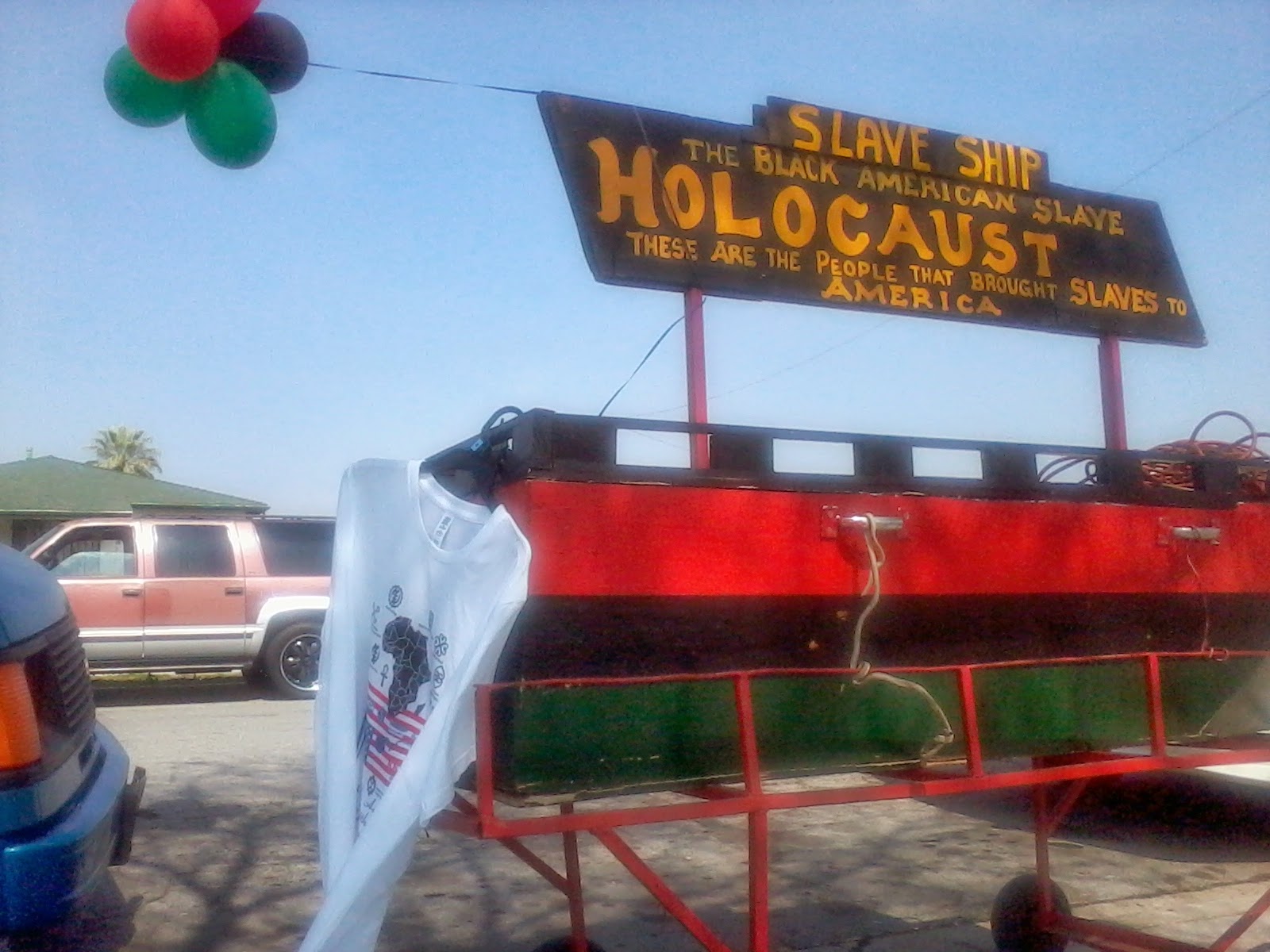

On the basketball court, the drumming.
A middle-aged black belly dancer.

There is a small crowd of about 30 or so people scattered in booths. What are they selling? Shirts, food, but mostly to promote National Reparations Day (NRD).
I see men dressed in Nation of Islam-like clothing --- suit with a bowtie.
I wonder how they in particular would receive me, an ambiguous-looking maybe Latino, maybe Asian man in an event dedicated to "their" cause.
No one talks to me as I wonder and glance at the dancers on the basketball court. In my head, I'm replaying scenes at the church where we were talking with long-time parishioners, and one of them makes the comment to my fiance about soothing over Latino-black relations, "it takes one person."
I walk hesitantly towards the booths trying to understand what "this" is all about. I mean, I know what it's about, but I have a few questions about how such a celebration/movement was brought on this particular day.
Why March 6th? Any significance to it?
I seek out the booths, glancing at who might be receptive to my inquiries. I look for a booth with flyers and giveaways.
After some initial hesitation, I approach that booth with the flyers, hoping to learn more.
A middle-aged woman wearing a shirt naming Latin American countries also in the African diaspora.
She doesn't really give me an answer about why March 6 other than to say "it's time." Her way of saying, "if not now, then when."
She appears to be surprised and impressed by my mere appearance at this gathering at the edge of West Compton.
She talks to me about how the younger generation doesn't seem to understand the impacts of slavery. She likens the experience of slavery to a holocaust, mostly as a way for the younger generation to understand the emotional toll it exacts on people today.
Richard Sherman Is Probably Smarter Than You - Chronicling Compton - January 22, 2014
Richard Sherman Is Probably Smarter Than You: The Export Report
Well, by now, a lot of commentary has been laid upon Richard Sherman for an interview he gave immediately after having made the key play that took his team to the Super Bowl.
I'll be honest. As a casual NFL fan whose loyalties are with Da Bears, and non-native of Compton, I didn't even know who he was during the game.
I'd vaguely recalled some guy with dreadlocks getting burned a few times by Kaepernick. I'd thought that was Richard Sherman. However I was informed by said best man, that he'd only been thrown to twice.
Turns out that Richard Sherman is actually one of the top cornerbacks/defensive players in the entire NFL.
And he hails from...
Dominguez High.
He graduated #2 in his class with a 1400 (out of 1600) on his SATs, went to Stanford, yeah, that's more than a lot of people already.
Not that these accomplishments and stats are an end-all be-all for intelligence, but it doesn't seem like it'd be smart for anyone to box him in with one label, particularly a negative one.
Before the game started, it was all about the Quarterbacks, Colin Kaepernick vs. Russell Wilson. Kaepernick looked great until that final interception. It seems like this will be the next big rivalry.
But after the game trolling the internet for rapid reaction to the game, expecting to see boo hooing 49er fans, I didn't find much except the video of Sherman.
The titles linking to the video were suggesting that this video was outrageous, hilarious, etc. etc.
I ignored these links initially, but then started seeing other people share it.
In the two question interview, Sherman didn't appear to answer the question posed to him, but instead made a super-enthusiastic, bold statement to the wide receiver that he had been covering all game, Michael Crabtree.
He basically said that he was the best and that the wide receiver Michael Crabtree was "mediocre."
Reaction ensued, with some predictably making comments with racial overtones. For instance, labelling him a "thug" or "cuckoo", the same predictable labels assigned to black athletes. I already knew what was coming in these posts.
The best piece of media re-buffing these labels? Richard Sherman himself.
I checked in with a conservative source, Michelle Malkin's Facebook page. She had over 5000 comments.
While there was a fair amount of labelling and prejudice-throwing based on that short interview, which (sadly) I've come to expect, I was sort of impressed at how there was some semblance of nuance in some peoples' answers, with some people actually defending him.
It's anecdotal, but I do follow that page every so often on key issues. There is very very little room for anyone to defend Obama. Anyone who defends on Obama policy on that page is hastily shouted down. However, there was considerably more positive, even nuanced reaction for Richard Sherman. People even seemed rational!
Reminds me of a quote by some French philosopher about how there is an intelligence people have reserved for sports that doesn't show a lot in other domains.
Here's a few of the better pieces about Mr. Sherman:
Compton in Pop Culture
Thinking about the Richard Sherman narrative, and how Compton is used as a synonym for hardship and struggle, it's always interesting how Compton is portrayed in various mediums in pop culture.
Unless they're talking about our new mayor, there isn't much positive yet.
There's a somewhat funny article about moving out of Southern California from a former Southern Californian: 20 Things Nobody Tells You About Moving Out of Southern California.
Check out slide #6.
Our beloved town is commented on:
In the News
There was a death on this very intersection about a week ago, as reported by Bikinginla.
A white man in his 50s who is identified as "Don Pete" was riding his bike very early before 5AM on a Wednesday morning.

The details as to what exactly happened are unclear.
A white bike has gone up on the Northwest corner of Compton Blvd and Dwight Ave in memoriam of Pete.
On the Southeast corner of Compton Blvd and Dwight Ave, another white bike has been a fixture for almost 4 years.
On February 15, 2010, in the broad daylight of a Monday morning at 8AM, a Ford utility van took out 40-year old Ovidio Morales, a father of five.

According to Bikinginla, the driver blew through a red light on a right turn from Dwight to Compton, and hit Morales, dragging him beneath the car.
The driver checked on him briefly, then fled the scene.
Eyewitnesses say that the driver was on a cell phone.
Despite the surveillance video footage, the case has remained unsolved.
So what's up with Dwight and Compton Blvd?
View Larger Map
As someone who regularly uses Compton Blvd. and crosses this very intersection quite regularly, usually to get to the Blue Line (and one time, the Compton Creek), I hate this fucking street.
There are two lanes, the right lane is narrow. The speed limit is 35.
I definitely didn't feel safe on Compton Blvd in general at current conditions even before knowing of these two deaths. I definitely would not allow my non-bike-commuting fiance to bike on anything other than the sidewalk. I feel even worse knowing about these tragedies.
Drivers appear to have caused their respective tragedies due to neglect while at this particular intersection.
There doesn't seem to be anything especially dangerous in the environment other than scant lighting in the 5AM darkness that took away Don Pete. I'm not sure what the excuse was for the Ovidio's killer.
It's these deaths and the fecklessness with which they seem to be treated that make me believe that when it comes to biking, physical environmental change is much more important and critical than simply "education" or an attitudinal shift and bike awareness for drivers --- the only way they get that is by riding a bike themselves on the street.
Neighbors Who Care
I didn't want to end on a negative note, well mostly not negative, unless you're part of Government public works or whoever the hell picks up our trash.
We took down our Christmas tree right on the morning of Wednesday, January 8th. I de-ornamentized the tree, swept up everything, and plopped the Christmas tree right next to our garbage cans so that the garbageman could pick them up, the next day, Thursday, the trash day.
I'd been planning to cut it up and dump in in the green trash can, the plant refuse can, but then I read on an LA County website that I would be able to leave a Christmas tree there. See Below.


I didn't see anywhere where Compton had any special instructions.
Of course when Thursday came, nobody actually picked it up. It remained sitting in the sidewalk for a few days.
By the next Tuesday it had been kicked aside and was lying down, as if some kids had just fooled around with it. I mean, yes it was trash, but still that was our tree.
It looked so hopeless.
I was working and too lazy to retrieve it till the time came, which in retrospect is no excuse at all. However, I wouldn't have been given the chance to write this bit.
Before I left for work on Thursday morning during the next trash day, I had to roll out the trash cans. I rolled our cans out and looked for our tree, only to find it stuffed in our neighbors' green trash can.
I wasn't sure how, why, and/or when but they took care of it.
Well, by now, a lot of commentary has been laid upon Richard Sherman for an interview he gave immediately after having made the key play that took his team to the Super Bowl.
I'll be honest. As a casual NFL fan whose loyalties are with Da Bears, and non-native of Compton, I didn't even know who he was during the game.
I'd vaguely recalled some guy with dreadlocks getting burned a few times by Kaepernick. I'd thought that was Richard Sherman. However I was informed by said best man, that he'd only been thrown to twice.
Turns out that Richard Sherman is actually one of the top cornerbacks/defensive players in the entire NFL.
And he hails from...
Dominguez High.
He graduated #2 in his class with a 1400 (out of 1600) on his SATs, went to Stanford, yeah, that's more than a lot of people already.
Not that these accomplishments and stats are an end-all be-all for intelligence, but it doesn't seem like it'd be smart for anyone to box him in with one label, particularly a negative one.
Before the game started, it was all about the Quarterbacks, Colin Kaepernick vs. Russell Wilson. Kaepernick looked great until that final interception. It seems like this will be the next big rivalry.
But after the game trolling the internet for rapid reaction to the game, expecting to see boo hooing 49er fans, I didn't find much except the video of Sherman.
The titles linking to the video were suggesting that this video was outrageous, hilarious, etc. etc.
I ignored these links initially, but then started seeing other people share it.
In the two question interview, Sherman didn't appear to answer the question posed to him, but instead made a super-enthusiastic, bold statement to the wide receiver that he had been covering all game, Michael Crabtree.
He basically said that he was the best and that the wide receiver Michael Crabtree was "mediocre."
Reaction ensued, with some predictably making comments with racial overtones. For instance, labelling him a "thug" or "cuckoo", the same predictable labels assigned to black athletes. I already knew what was coming in these posts.
The best piece of media re-buffing these labels? Richard Sherman himself.
"There was a hockey game where they didn't even play hockey, they just threw the puck aside and started fighting. I saw that, and said, 'Oh man, I'm the thug? What's going on here?'"
I know some 'thugs,' and they know I'm the furthest thing from a thug. I've fought that my whole life, just coming from where I'm coming from. Just because you hear Compton, you hear Watts, you hear cities like that, you just think 'thug, he's a gangster, he's this, that, and the other,' and then you hear Stanford, and they're like, 'oh man, that doesn't even make sense, that's an oxymoron.'
"You fight it for so long, and to have it come back up and people start to use it again, it's frustrating."
I checked in with a conservative source, Michelle Malkin's Facebook page. She had over 5000 comments.
While there was a fair amount of labelling and prejudice-throwing based on that short interview, which (sadly) I've come to expect, I was sort of impressed at how there was some semblance of nuance in some peoples' answers, with some people actually defending him.
It's anecdotal, but I do follow that page every so often on key issues. There is very very little room for anyone to defend Obama. Anyone who defends on Obama policy on that page is hastily shouted down. However, there was considerably more positive, even nuanced reaction for Richard Sherman. People even seemed rational!
Reminds me of a quote by some French philosopher about how there is an intelligence people have reserved for sports that doesn't show a lot in other domains.
Here's a few of the better pieces about Mr. Sherman:
- Richard Sherman to High Schoolers (Business Insider)
- What Richard Sherman Taught Us About America (Huffington Post)
- Richard Sherman and the Thug Athlete Narrative (Grantland)
Compton in Pop Culture
Thinking about the Richard Sherman narrative, and how Compton is used as a synonym for hardship and struggle, it's always interesting how Compton is portrayed in various mediums in pop culture.
Unless they're talking about our new mayor, there isn't much positive yet.
There's a somewhat funny article about moving out of Southern California from a former Southern Californian: 20 Things Nobody Tells You About Moving Out of Southern California.
Check out slide #6.
Our beloved town is commented on:
To you, Compton is just a place off the 105 freeway that used to have a high murder rate but is actually pretty chill now.
To the rest of the country, Compton is like Somalia. Even the word "Compton" is used as a synonym for Murdertown USA. Tell someone you grew up in Southern California, they immediately want to know if you've been to Compton. When you tell them you have, they immediately think you're a Special Forces level badass.
In the News
- Family getting sick by carbon monoxide on Tamarind St (CBS)
- No one injured in Deputy-involved shooting on Magnolia and Acacia (CBS)
- Serena Williams actually lost, and a fellow player apparently cheered it on (LA Times)
- Former UCLAer, current Orlando Magic guard, Arron Afflalo and Richland Farms (Orlando Sentinel)
There was a death on this very intersection about a week ago, as reported by Bikinginla.
A white man in his 50s who is identified as "Don Pete" was riding his bike very early before 5AM on a Wednesday morning.
The details as to what exactly happened are unclear.
A white bike has gone up on the Northwest corner of Compton Blvd and Dwight Ave in memoriam of Pete.
On the Southeast corner of Compton Blvd and Dwight Ave, another white bike has been a fixture for almost 4 years.
On February 15, 2010, in the broad daylight of a Monday morning at 8AM, a Ford utility van took out 40-year old Ovidio Morales, a father of five.
According to Bikinginla, the driver blew through a red light on a right turn from Dwight to Compton, and hit Morales, dragging him beneath the car.
The driver checked on him briefly, then fled the scene.
Eyewitnesses say that the driver was on a cell phone.
Despite the surveillance video footage, the case has remained unsolved.
So what's up with Dwight and Compton Blvd?
View Larger Map
As someone who regularly uses Compton Blvd. and crosses this very intersection quite regularly, usually to get to the Blue Line (and one time, the Compton Creek), I hate this fucking street.
There are two lanes, the right lane is narrow. The speed limit is 35.
I definitely didn't feel safe on Compton Blvd in general at current conditions even before knowing of these two deaths. I definitely would not allow my non-bike-commuting fiance to bike on anything other than the sidewalk. I feel even worse knowing about these tragedies.
Drivers appear to have caused their respective tragedies due to neglect while at this particular intersection.
There doesn't seem to be anything especially dangerous in the environment other than scant lighting in the 5AM darkness that took away Don Pete. I'm not sure what the excuse was for the Ovidio's killer.
It's these deaths and the fecklessness with which they seem to be treated that make me believe that when it comes to biking, physical environmental change is much more important and critical than simply "education" or an attitudinal shift and bike awareness for drivers --- the only way they get that is by riding a bike themselves on the street.
Neighbors Who Care
I didn't want to end on a negative note, well mostly not negative, unless you're part of Government public works or whoever the hell picks up our trash.
We took down our Christmas tree right on the morning of Wednesday, January 8th. I de-ornamentized the tree, swept up everything, and plopped the Christmas tree right next to our garbage cans so that the garbageman could pick them up, the next day, Thursday, the trash day.
I'd been planning to cut it up and dump in in the green trash can, the plant refuse can, but then I read on an LA County website that I would be able to leave a Christmas tree there. See Below.
I didn't see anywhere where Compton had any special instructions.
Of course when Thursday came, nobody actually picked it up. It remained sitting in the sidewalk for a few days.
By the next Tuesday it had been kicked aside and was lying down, as if some kids had just fooled around with it. I mean, yes it was trash, but still that was our tree.
It looked so hopeless.
I was working and too lazy to retrieve it till the time came, which in retrospect is no excuse at all. However, I wouldn't have been given the chance to write this bit.
Before I left for work on Thursday morning during the next trash day, I had to roll out the trash cans. I rolled our cans out and looked for our tree, only to find it stuffed in our neighbors' green trash can.
I wasn't sure how, why, and/or when but they took care of it.
Subscribe to:
Posts (Atom)